
What Is a Car Negotiation Service and How Does It Work?
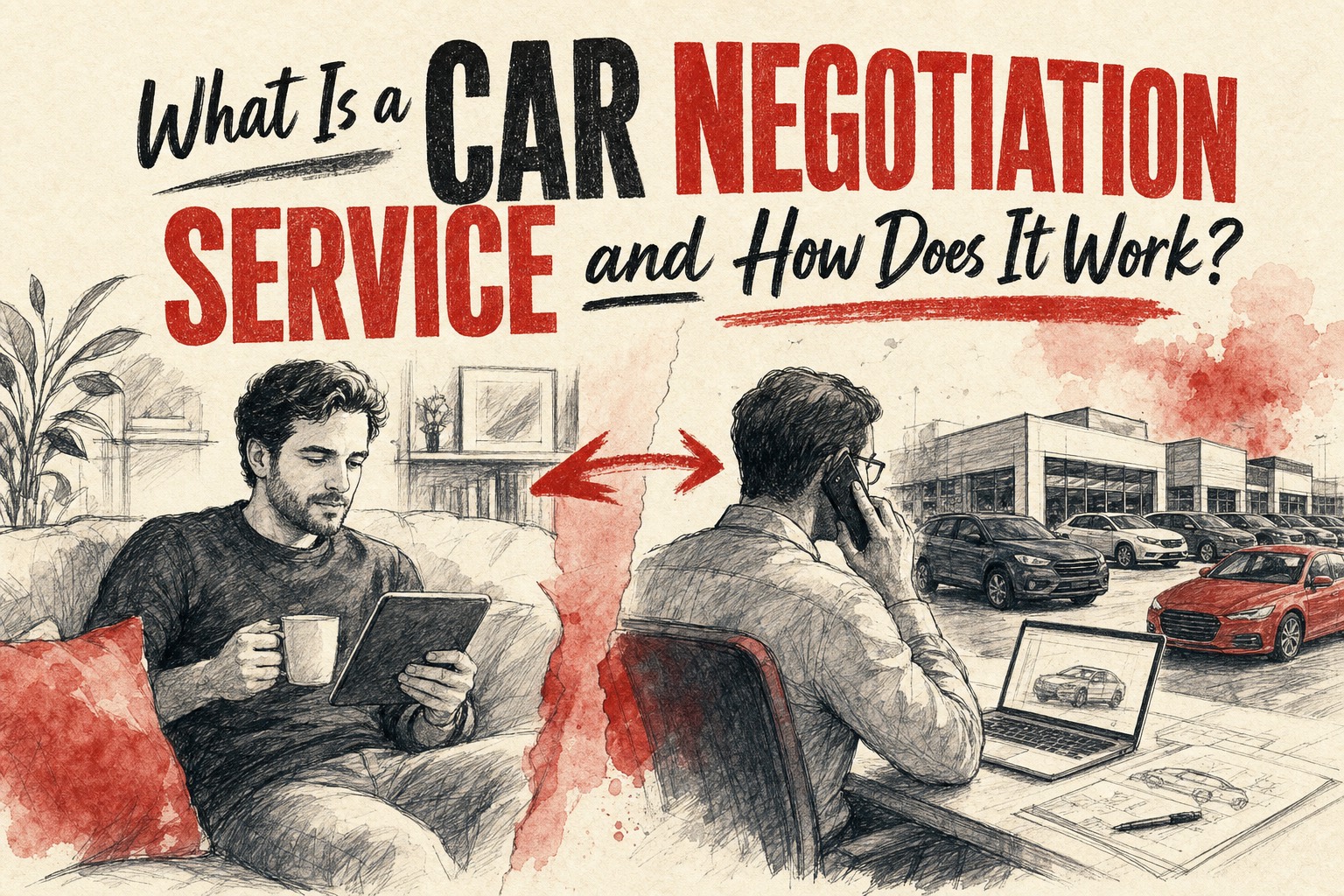
A car negotiation service is a person or company you pay to handle the haggling on a vehicle purchase for you: they contact dealerships, negotiate the price and fees, and hand you a finished deal, usually for a flat fee or a percentage of what they save. In the fuller version of the category, the service also runs the search, the trade-in, and the financing, and reviews the finance-office paperwork before you sign. Based on Rolo Rides' published delivery model, a full engagement of this kind is completed by phone from anywhere in the United States, most engagements close within 48 hours, and the buyer's own time involvement is typically 30 minutes to an hour.
If your calendar is the scarce thing, the appeal is obvious. A car is one of the larger checks you will write this year, the dealership process is built to run long, and handing the whole thing to someone who does it every week is a sensible trade. The catch is that the phrase car negotiation service covers several very different businesses, and the differences between them are mostly hidden in how each one gets paid.
The reality is that negotiation is only part of where money is lost on a car. The finance office, the trade-in, and the add-on menu each carry their own margin, and a service that only touches the sticker price leaves the rest untouched. Which model you should hire depends on how many of those pieces are moving in your purchase, and on whether the service answers to you or to the dealer.
One more thing before you compare any of them: none of this requires the service to be in your city. The negotiation happens by phone and email, dealers answer written quote requests from anywhere, and the process described on this site has been run for clients in nine states without the buyer or the negotiator setting foot in a showroom.
Key Insights
The short version: a car negotiation service ranges from a one-job negotiator who works the sticker price to a full buyer's advocate who sources the car, negotiates price and fees, protects the finance rate, handles the trade-in, and coordinates delivery. The single most useful question is who pays the service, because a buyer-paid, flat-fee advocate that accepts nothing from dealers has no reason to steer you toward a pricier car or a marked-up loan. In Rolo Rides' published model the fee is a flat $999, the client's time is typically 30 minutes to an hour, and most engagements close within 48 hours. The fee makes sense when the money on the table (price, rate, and fees on a new vehicle) comfortably exceeds it, and it makes less sense on a small cash purchase.
What this guide covers
- What Does a Car Negotiation Service Actually Do?
- Is a Negotiation-Only Service the Same as a Full Car Buying Advocate?
- Who Pays the Service, and Why Does That Change the Advice You Get?
- How Is an Advocate Different From a Broker?
- What Does the Process Look Like in Practice?
- When Is a Car Negotiation Service Worth the Fee?
- What Are the Red Flags When Choosing One?
What Does a Car Negotiation Service Actually Do?
At its narrowest, a car negotiation service does one job: you tell them the vehicle you want, and they contact dealerships and negotiate the price so you do not have to. Some work from a car you have already found. Others reach out to several dealers at once to create competing offers, then bring the best written quote back to you. You still buy the car from the dealership directly; the service is the voice on the phone in the middle.
The reason this works is not magic. A dealership salesperson negotiates every day, and most buyers negotiate once every several years. A professional negotiator closes that experience gap, and just as importantly, they are not sitting in the showroom under time pressure. They can ask ten dealers the same question in writing, wait for the answers, and let the dealers compete with each other rather than with the buyer's patience.
The number the service should be working toward is the out-the-door price: the total you will pay including the vehicle, taxes, title, registration, and every dealer fee. The Federal Trade Commission's own guidance to buyers makes the same point, warning against focusing only on the monthly payment because the total amount you pay depends on the negotiated price, the APR, and the length of the loan. A negotiation service that reports back a monthly payment instead of a total has not finished the job.
Rolo Rides founder Andrew Eder spent five years inside four dealerships, including managing a finance office at a Honda store, before switching to the buyer's side. His method, described on the How It Works page, contacts 10 or more dealerships per engagement and evaluates every offer on price and fees, finance structure, trade-in value, and dealer reputation as one coordinated transaction rather than four separate arguments.
Is a Negotiation-Only Service the Same as a Full Car Buying Advocate?
No, and the difference is where the money is. A negotiation-only service works the sticker price. A full advocate handles the whole purchase: the search for the right vehicle, the multi-dealer negotiation on price and fees, the trade-in, the financing, the finance-office review, and the paperwork and delivery. Both are legitimate products. They are just different sizes of job, and the smaller one leaves several profit centers untouched.
The finance office is the clearest example. When a dealer arranges your loan, the Consumer Financial Protection Bureau explains that the rate you are offered is generally the lender's buy rate plus additional interest that compensates the dealer for handling the financing. An MIT analysis reported by NerdWallet found that about 78% of dealer-arranged loans carry marked-up interest rates, with an average markup of 1.13 percentage points. A service that negotiated a great price and then left you alone in that room has handed part of the saving straight back.
The trade-in is the second place. Dealers like to blend the trade-in value, the purchase price, and the financing into one monthly figure, because a good number on one line can quietly pay for a bad number on another. A full advocate keeps the three figures separate and negotiates each on its own. If you are working the deal yourself, the guide on how to negotiate a car price without going to the dealership walks through that discipline step by step.
In Rolo Rides' published model the whole purchase is one flat fee. The Shopping Phase diagnoses the right vehicle across six dimensions (Needs, Wants, Budget Reality, Total Cost of Ownership, Resale and Depreciation, and Pressure-Free Evaluation), and the Buying Phase executes the deal across four (Dealer Reputation and Sourcing, Price and Fees, Finance Structure, and Trade-in Value). That is the full-advocate shape of the category, and it is worth knowing the shape even if you hire someone else to fill it.
Who Pays the Service, and Why Does That Change the Advice You Get?
This is the question most buyers skip, and it is the one that sets every other incentive. There are two basic models. In the dealer-paid model, the service costs you nothing, or nearly nothing, because the dealers in its network pay to be there. Costco's own Auto Program site states plainly that a participation fee has been paid by the dealers participating in the program. That is an honest way to run a service, and for a straightforward purchase a prearranged price at a network dealer can be a perfectly good outcome.
But it is worth being clear about what a dealer-paid service is and is not. It is a referral into a curated network at a prearranged price. It is not a person on your side of the table arguing about the doc fee, the add-ons, or the interest rate, because the dealer is the paying customer. The service's business depends on dealers wanting to stay in the network, and that shapes how hard anyone pushes on your behalf.
In the buyer-paid model, you pay the fee and the service accepts nothing from the dealer. The fee shape varies across the category: some charge a flat fee, some charge a retainer plus a percentage of the savings they can show, and some charge a percentage of the vehicle price. Each of those shapes creates its own incentive. A percentage of the vehicle price rewards a pricier car. A percentage of savings rewards a high starting quote. A flat fee rewards nothing except finishing the job.
Rolo Rides is paid a flat $999 by the buyer, upfront, and accepts zero compensation from any dealership. The fee is paid before a single dealership is contacted, which is the point: once the fee is settled, there is no commission, no kickback, and no reason to steer anyone toward a higher-priced vehicle or a dealer-arranged loan. Whatever service you hire, ask that question in writing and keep the answer.
How Is an Advocate Different From a Broker?
The words get used interchangeably online, and they describe two structurally different businesses. A broker, as the term is used in car retail, buys the vehicle from the dealership and resells it to you. The broker takes title to the car, sets a resale price with a margin inside it, and often receives dealer-side commissions as well. You are buying from the broker, and the broker's profit lives in the gap between what they paid and what you paid. That gap is usually not itemized, so you cannot see how much of your money the middle step consumed.
An advocate never takes title. The dealership sells the car directly to you, at a price the advocate negotiated on your behalf, and the advocate is paid a fee by you rather than a margin hidden in the vehicle. There is no resale, so there is no markup to hide, and if the advocate accepts no dealer compensation there is no second paymaster either. The difference is not a slogan. It is who owns the car at each moment, and who is paying whom.
That is the mechanism to check rather than the label. Ask any service three questions: does your company ever purchase or take title to the vehicle, does the dealership sell directly to me, and do you receive any payment from the dealer or lender on my deal. The answers tell you what kind of business you are dealing with regardless of what it calls itself.
Rolo Rides' answers are published on its own site: it never purchases or takes title to any vehicle, the dealership sells directly to you, and the only payment on the deal is the flat fee from the buyer. Andrew Eder also does not profit from warranty sales, protection products, or any dealership add-on, which matters because those products are where a dealer-paid intermediary would most quietly earn.
What Does the Process Look Like in Practice?
The process varies by company, so the description below is the one Rolo Rides publishes for its own engagements, and it is a fair picture of what a full-service advocate does end to end. Everything happens by phone and email, from anywhere in the United States, and the client's part of it is typically 30 minutes to an hour spread across one or two calls.
It starts with a free discovery call. You describe what you are looking for, and Andrew tells you whether he can help and what to expect. If he does not think he can deliver enough value to justify the fee, he says so. If you proceed, the flat fee is paid upfront via Stripe, and only then does dealer contact begin.
Then comes the Shopping Phase. If you already know the exact vehicle, this is fast. If you do not, it is a structured diagnosis of what you actually need: needs and wants, budget reality, total cost of ownership, resale and depreciation, and a pressure-free evaluation, including low-pressure test drives arranged in advance so no one is closing you on the lot.
The Buying Phase is the execution. Ten or more dealerships are contacted to source the exact spec, every offer is evaluated on price and fees, finance structure, trade-in value, and dealer reputation, and the finance-office review happens before you sign anything: an interest-rate markup check and a dealer add-on and fee audit, with financing coordinated through your own bank or credit union where that is the better rate. Paperwork is coordinated, e-signed where available, and the car is delivered to your door where available. Most engagements close within 48 hours of the fee being paid. That turnaround is typical rather than promised, and the first call is the place to ask how your particular purchase would run.
When Is a Car Negotiation Service Worth the Fee?
The honest answer is arithmetic, not adjectives. Put the fee on one side and the money that is actually on the table on the other. The money on the table is not just the discount off the sticker; it is the price, the finance-rate markup, the dealer fees and add-ons, and the hours you would otherwise spend. If the second column comfortably exceeds the first, the service earns its fee. If it does not, do it yourself with a clear conscience.
Rolo Rides publishes the worked example it uses with clients. On a typical $50,000 new vehicle, its historical client outcomes average around 10% off MSRP, roughly $5,000; financing-rate protection of 1 to 2 percentage points, roughly $1,400 over the loan; dealer fees reduced by $500 to $2,000; and 10 to 15 hours of the buyer's time reclaimed. Against a flat $999 fee, the math is not close. Those are past outcomes on new vehicles, every deal is different, and no specific result is guaranteed.
The same arithmetic tells you when the fee is the wrong shape. On a low-priced used car bought for cash with no trade-in, the plausible saving may not clear the fee by much, and a flat fee is simply too large a slice of a small purchase. An experienced negotiator buying a vehicle they have already priced across several dealers may not need the help either. The fee earns its keep as the deal gets more complicated: a loan arranged through the dealer, a car to trade, a finance office with a product menu, and a specific trim that only a handful of dealers have on the lot.
The full version of that comparison, including a side-by-side of do-it-yourself against professional negotiation, is in Is Hiring a Car Buying Service Worth the Money?. This article's job is to define the category; that one runs the numbers.
What Are the Red Flags When Choosing One?
Because the label car negotiation service covers such different businesses, the warning signs are mostly about what a company will not tell you. A service that is genuinely working for you has no reason to be vague about who pays it, what it costs, or what happens to the car between the dealer and your driveway.
The first red flag is a fee you cannot find. If the price is not published anywhere and only appears after a sales conversation, that tells you something about how the rest of the engagement will go. The second is any hesitation on the dealer-compensation question. A service that accepts referral fees, placement fees, or commissions from dealers or lenders may still be useful, but it is not an advocate in the sense described above, and it should say so plainly.
The third is a guaranteed savings figure. Historical averages are honest; a promised number on a deal that has not been negotiated yet is not, because the dealer, the vehicle, and the market decide the outcome. The fourth is a service that reports back a monthly payment rather than an out-the-door total. The Consumer Financial Protection Bureau's guidance to car buyers is blunt about this: many people think about a loan in terms of the monthly payment, but the total cost of the loan is what matters. A negotiator who has adopted the dealer's framing is not negotiating on your behalf.
The last is title. Ask whether the company ever purchases or takes title to the vehicle. If it does, you are buying from a reseller with a margin inside the price, and you should treat its quoted price as a starting point rather than a finished deal. A checklist of the specific questions to put to any service before you hire one is a separate guide on this site; this article's point is simpler. The mechanism behind each answer is what you are checking, and the mechanism is always the same three things: who pays, who owns the car, and what number they hand you at the end.
Ready to have the whole purchase handled?
If you have more money than time and would rather never sit in a showroom, the free discovery call is the place to find out whether the fee makes sense for your purchase. Andrew will tell you straight if it does not. You can also read how the Shopping Phase and Buying Phase run on the How It Works page first.
Andrew Eder spent five years inside four dealerships and has been involved in over 1,000 vehicle transactions across sales, finance management, and buyer representation. That experience now sits on the buyer's side of the desk, by phone, anywhere in the United States.
Frequently asked questions
Q: What does a car negotiation service actually do, and is it worth it?
A: A car negotiation service contacts dealerships and negotiates the vehicle price on your behalf; a full buyer's advocate goes further and also sources the car, negotiates fees, protects the finance rate, handles the trade-in, and reviews the paperwork before you sign. It is worth the fee when the money on the table (price, rate markup, and dealer fees, usually on a new vehicle) clearly exceeds it. Rolo Rides publishes a worked example on a $50,000 new car showing historical averages of about 10% off MSRP plus rate and fee savings against a flat $999 fee; those are past outcomes and results vary.
Q: Do I still buy the car from the dealership if I use a car negotiation service?
A: With an advocate, yes. The service negotiates the deal, and the dealership sells the vehicle directly to you at the negotiated price, so the title passes from the dealer to you and no reseller's margin sits in the middle. The exception is a company that operates as a broker, which buys the vehicle and resells it to you with a markup. Ask any service whether it ever takes title; an advocate should be able to say plainly that it never purchases or takes title to any vehicle.
Q: How long does a car negotiation service take, and how much of my time does it need?
A: It depends on the company and on whether you already know the exact vehicle. In Rolo Rides' published model, everything runs by phone and email from anywhere in the United States, most engagements close within 48 hours of the flat fee being paid, and the buyer's own time involvement is typically 30 minutes to an hour across one or two calls. Turnaround is typical rather than guaranteed, and the discovery call is where to ask how your purchase would run.
Q: How do I get started with a car negotiation service?
A: Start with the question that decides everything else: who pays the service, and does it accept any money from dealers or lenders on your deal. Then confirm the fee, whether it is published, and whether the company ever takes title to the car. With a flat-fee advocate of the kind described here, the first step is a free discovery call with no payment upfront, where Andrew Eder tells you whether he can deliver enough value to justify the fee. If the answer is yes, the flat fee is paid and dealer contact begins.
Citations
- Financing or Leasing a Car (Federal Trade Commission). The FTC's consumer guidance confirms that dealers typically profit from offering financing, advises getting pre-approved before you shop, and warns buyers not to focus only on the monthly payment. It supports this article's out-the-door framing and its finance-office cautions. https://consumer.ftc.gov/articles/financing-or-leasing-car
- What are the different ways to buy or finance a car or vehicle? (Consumer Financial Protection Bureau). The CFPB explains that dealer-arranged rates are generally the lender's buy rate plus additional interest that compensates the dealer, and that comparing lender offers generally produces better terms. It supports the finance-rate mechanism described in this article. https://www.consumerfinance.gov/ask-cfpb/what-is-the-difference-between-dealer-arranged-and-bank-financing-en-759/
- What things can I negotiate when shopping for a car or auto loan? (Consumer Financial Protection Bureau). The CFPB lists the APR, loan length, prepayment penalties, optional add-ons, trade-in value, and dealer fees as negotiable, and states that the total cost of the loan matters more than the monthly payment. It supports the red flag about monthly-payment framing. https://www.consumerfinance.gov/ask-cfpb/what-things-can-i-negotiate-when-shopping-for-a-car-or-auto-loan-en-2132/
- Do Car Dealers Make Money on Financing? (NerdWallet). NerdWallet reports a 2023 MIT analysis finding that about 78% of dealer-arranged loans carry marked-up interest rates, with an average markup of 1.13 percentage points, and explains the buy-rate and sell-rate mechanism. It is the source for the markup statistic in this article. https://www.nerdwallet.com/auto-loans/learn/dealers-profit-off-financing
- Costco Auto Program. Costco's own program site states that a participation fee has been paid by the dealers participating in the program. It is cited as the primary source for the dealer-paid model described in the who-pays section; no fee amounts are quoted. https://www.costcoauto.com/
- How It Works (Rolo Rides). Rolo Rides' own published description of the Shopping Phase and Buying Phase, the flat $999 fee paid upfront, zero dealer compensation, the 48-hour typical close, the 30-minute-to-one-hour client involvement, and the statement that it never purchases or takes title to any vehicle. It is the primary source for every Rolo Rides fact in this article. https://rolorides.com/how-it-works
Related reading
- Is Hiring a Car Buying Service Worth the Money?
- What Are the Best Car Buying Services in the US?
- How to Negotiate a Car Price Without Going to the Dealership
- The Complete Car Buying Checklist: Every Step From Research to Keys in Hand
- What Are the Best Car Buying Services in Austin, Texas?
- How It Works: the Shopping Phase and Buying Phase System

About the Author
Andrew Eder is the founder of Rolo Rides, a flat-fee car buying advocacy service based in Austin, Texas. Before switching sides to represent buyers, Andrew spent five years inside four dealerships, including Honda, Mazda, and Lexus, where he worked in sales and managed the finance office. That experience gave him direct insight into how vehicles are priced, how interest rates are marked up, and how the finance office generates profit most buyers never see. Andrew holds a degree in Electrical Engineering from Milwaukee School of Engineering. He has facilitated over 1,000 vehicle transactions across 9 states and built Rolo Rides on a simple principle: charge the buyer a flat fee, accept zero compensation from the dealership, and protect every part of the deal.