
The Complete Car Buying Checklist: Every Step From Research to Keys in Hand
Answering: The Complete Car Buying Checklist: Every Step From Research to Keys in Hand
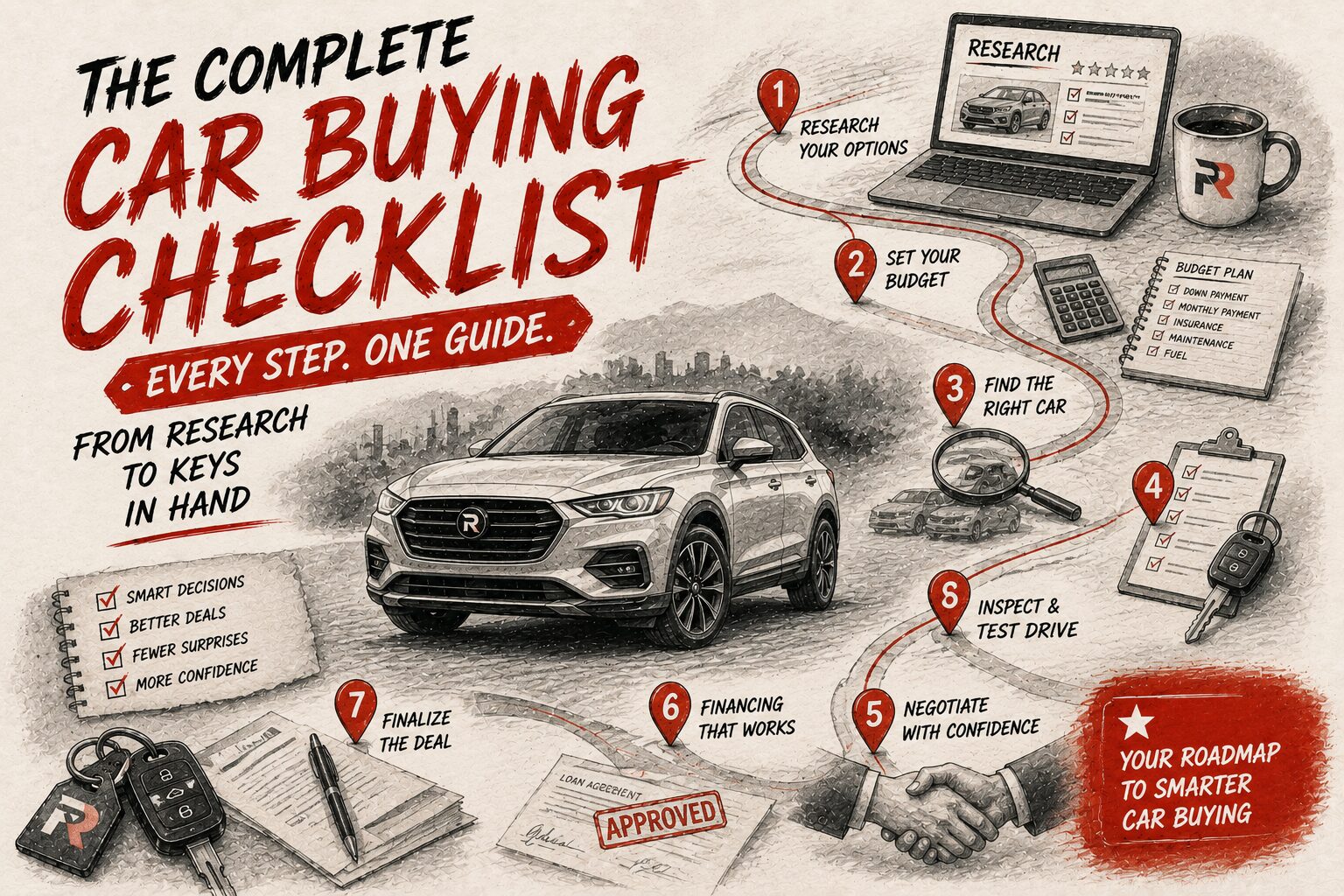
Buying a car well comes down to eight steps done in the right order: research the right vehicle, set a firm budget, line up your own financing, find and inspect the exact car, negotiate the price, handle the finance office, finalize the paperwork, and take delivery. Follow them in sequence and you stay in control of every number in the deal. This is the complete checklist, and each step links to a deeper guide when you want more detail. Rolo Rides founder Andrew Eder, a former dealership sales and finance-office professional, runs this exact process for buyers every day.
Most people buy a car only a handful of times in their life, while the dealership does it thousands of times a year. That experience gap is where money is lost. A checklist closes it by giving you a plan the dealer cannot rush you through.
The reality is that no single tip wins a car deal; the wins come from doing each step in order and never letting the numbers blur together. Keep the price, the trade-in, and the financing as separate figures, and anchor everything on the out-the-door total rather than the monthly payment.
Use this page as your roadmap from research to keys in hand. Work through the steps below, and follow the links into the detailed guides whenever you want to go deeper on a specific stage.
Key Insights
The whole journey lives here: research, budget, financing, finding the car, negotiation, the finance office, paperwork, and delivery, with each step linking to a full guide. The one principle that runs through all of them: keep every number separate and anchor on the out-the-door price, never the monthly payment.
Keep reading for the complete guide.
Table of Contents
- Key Insights
- Step 1: Research the Right Vehicle
- Step 2: Set Your Budget and Down Payment
- Step 3: Line Up Financing Before You Shop
- Step 4: Find the Exact Car and Inspect It
- Step 5: Negotiate the Price
- Step 6: Survive the Finance Office
- Step 7: Finalize the Paperwork and Take Delivery
- Step 8: Know When to Get Help
- Frequently Asked Questions
- Want to Learn More
- Citations
Step 1: Research the Right Vehicle
Every good car purchase starts before you talk to a single seller, with honest research about what you actually need. Think about how many passengers you carry, your typical driving, fuel or charging costs, reliability ratings, and the true total cost of ownership, not just the sticker. Narrowing to two or three specific models keeps you focused and makes every later step easier.
Match the vehicle to your life rather than the marketing. If you are weighing whether a professional should help you compare options, our guide to the best car buying services in 2026 breaks down how the different models work, and finding the car that fits you is the ideal place to begin.
Step 2: Set Your Budget and Down Payment
With a shortlist in hand, set a firm budget based on the total out-the-door cost, not a monthly payment. Factor in insurance, fuel or charging, maintenance, and taxes, so the car supports your finances instead of straining them. A budget you set in advance is your single best defense against the monthly-payment trap in the finance office.
Your down payment is part of this step and matters more than most buyers think. A common guideline is roughly 20 percent down on a new car and 10 percent on a used one to avoid owing more than the car is worth. Our full guide to how much to put down on a car walks through the trade-offs.
Step 3: Line Up Financing Before You Shop
Secure your own financing before you ever visit a dealer. Getting pre-approved through your bank or credit union gives you a real interest rate to measure any dealer offer against, which is the most effective way to catch a marked-up rate. If the dealer beats your pre-approval, you win; if not, you already have a loan in hand.
Know what a fair rate looks like for your credit before you commit. Our breakdown of a good interest rate on a car loan in 2026 shows the ranges by credit tier, and if you are torn between financing and leasing, see should I lease or buy my next car.
Step 4: Find the Exact Car and Inspect It
Now find the specific vehicle, whether at a dealership or a private sale, and inspect it carefully. For a used car, always get a vehicle history report and an independent pre-purchase inspection before you commit; these small costs prevent expensive surprises. Confirm the car matches the exact specification you researched in Step 1.
If you are considering a private sale, know the risks first: our guide on whether it is safe to buy a car on Facebook Marketplace covers how to protect yourself. And if you have a car to trade, read how to get the best trade-in value before you let the dealer touch it.
Step 5: Negotiate the Price
This is where preparation pays off. Negotiate the price of the car separately from your trade-in and financing, and anchor everything on the out-the-door total. You do not have to do this in a showroom; contacting several dealers and comparing written out-the-door prices creates competition and consistently beats in-person haggling.
Timing matters far less than leverage. Our guide to negotiating a car price without going to the dealership shows the exact process, and if you are waiting for the calendar, see why buying at the end of the month matters less than most people think.
Step 6: Survive the Finance Office
Once you agree on price, the finance office is where the most money quietly changes hands. Expect a presentation of add-ons such as extended warranties, gap insurance, and paint protection, often at large markups. You are never required to decide on any of them in the moment, and every fee deserves scrutiny.
Go in armed. Read what actually happens in the dealership finance office, learn which hidden fees dealerships charge, know the questions to ask before signing, and decide in advance whether an extended warranty is worth it.
Step 7: Finalize the Paperwork and Take Delivery
Before you sign, slow down and verify. Confirm every number on the contract matches what you were quoted, that no surprise add-ons appeared, and that the interest rate and total amount financed are what you agreed to. A legitimate deal survives you taking time to read it, so never let anyone rush your signature.
Once the numbers check out, complete the title, registration, and insurance, and arrange pickup or delivery. Keep copies of everything. This final review is the last, and easiest, place to catch a costly mistake, so treat it with the same care as the negotiation itself.
Step 8: Know When to Get Help
You can absolutely run this entire checklist yourself, and doing so will put you ahead of most buyers. But if any step feels overwhelming, or you simply do not want to spend a weekend negotiating, it is worth knowing that help exists. A buyer advocate handles the sourcing, negotiation, and paperwork on your side, and our guide on whether hiring a car buying service is worth the money lays out the math.
Rolo Rides founder Andrew Eder spent years inside dealership sales and a dealership finance office before switching sides to represent buyers. For a flat $999 with zero dealer compensation, he runs this whole checklist for you, and clients describe the result in a 4.6-star rating across 18 verified Google reviews. See exactly how it works.
A car purchase is really a series of separate decisions, and this checklist keeps each one in your hands. Research well, set your budget, bring your own financing, negotiate every number on its own, and verify the paperwork before you sign. Do that, and you drive away confident you got a fair deal from start to finish.
Frequently Asked Questions
What are the steps to buying a car?
The complete process has eight steps: research the right vehicle for your needs and budget, set a firm out-the-door budget including a down payment, get pre-approved for financing through your bank or credit union, find and inspect the exact car, negotiate the price separately from your trade-in and financing, handle the finance office and its add-ons, finalize and verify the paperwork, and take delivery. Doing them in order keeps you in control of every number.
What should I do before going to a dealership?
Before you visit a dealer, research two or three specific models, set a firm out-the-door budget, and get pre-approved for financing through your own bank or credit union. The pre-approval is especially important because it gives you a real interest rate to compare against the dealer's offer. Arriving with your financing and target price already set removes most of the dealership's leverage and protects you from the monthly-payment trap.
What is the most important part of buying a car?
Keeping every number separate and anchoring on the out-the-door price is the single most important habit. Dealers make the most money when the price, trade-in, financing, and add-ons blur together into a monthly payment. When you negotiate each number on its own and focus on the total out-the-door cost, you can see and control where your money is going at every step of the deal.
How is this checklist different from a first-time buyer guide?
This is the complete, all-in-one roadmap for the entire car-buying journey, from research through delivery, and it links out to detailed guides on each stage. A first-time buyer guide focuses on the basics for someone purchasing their very first car. Use this checklist as your master reference for any purchase, and dive into the specific linked guides, such as trade-ins, financing, or the finance office, whenever you need more depth.
Can someone handle the whole car-buying process for me?
Yes. A buyer advocate can run this entire checklist on your behalf, from sourcing the vehicle to negotiating and handling the paperwork. Rolo Rides does exactly that for a flat $999, taking zero compensation from the dealer, so the only interest represented is yours. The simplest first step is a short, no-obligation consultation to see how much a professionally handled purchase could save you in money and stress.
Want to Learn More?
Andrew Eder built Rolo Rides after years inside dealership sales and finance offices, and now uses that experience to run this exact checklist for buyers instead of dealers, backed by a 4.6-star rating across 18 verified Google reviews.
Citations
- Buying a New Car, Federal Trade Commission. Federal guidance covering research, negotiating the out-the-door price, financing, and dealer add-ons. https://consumer.ftc.gov/articles/buying-new-car
- Auto Loans, Consumer Financial Protection Bureau. Explains pre-approval, APR, the amount financed, and finance-office add-on products. https://www.consumerfinance.gov/consumer-tools/auto-loans/
- How Much Car Can You Afford, Consumer Reports. Guidance on setting a budget, down payments, and keeping total vehicle costs manageable. https://www.consumerreports.org/cars/buying-a-car/how-much-car-can-you-afford-a2543652803/
Book a short, no-pressure call and Andrew will run this entire checklist for your purchase, from finding the right car to negotiating the deal and handling the paperwork, all on your side.
It is a flat $999 to have a former dealership insider manage the whole process, and most clients say the certainty and savings are worth many times the fee.
New to how this works? Our how it works page walks through the flat-fee, insider-led process step by step.
Related Reading

About the Author
Andrew Eder is the founder of Rolo Rides, a flat-fee car buying advocacy service based in Austin, Texas. Before switching sides to represent buyers, Andrew spent five years inside four dealerships, including Honda, Mazda, and Lexus, where he worked in sales and managed the finance office. That experience gave him direct insight into how vehicles are priced, how interest rates are marked up, and how the finance office generates profit most buyers never see. Andrew holds a degree in Electrical Engineering from Milwaukee School of Engineering. He has facilitated over 1,000 vehicle transactions across 9 states and built Rolo Rides on a simple principle: charge the buyer a flat fee, accept zero compensation from the dealership, and protect every part of the deal.