
How to Buy a Car for the First Time
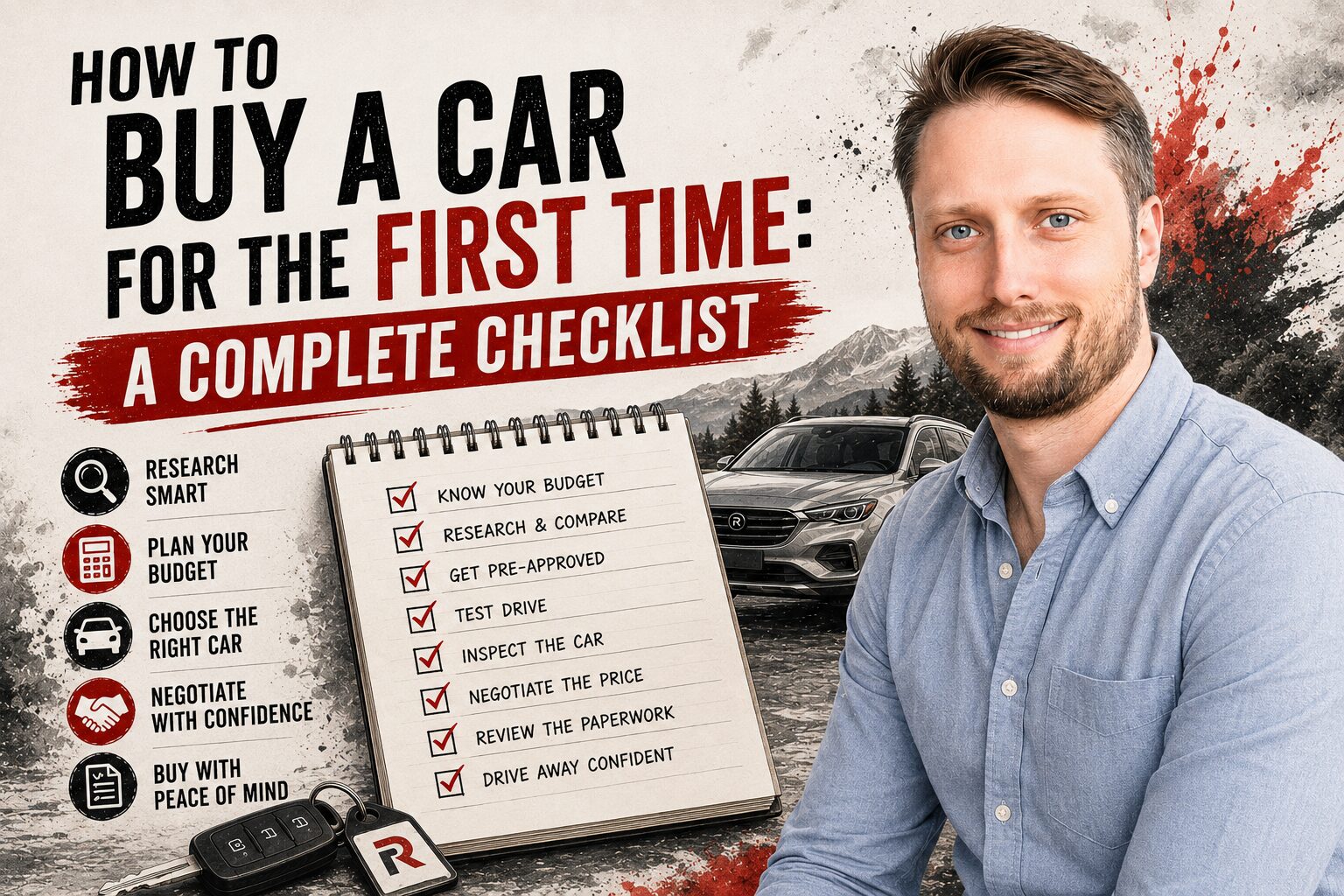
Answering: How to Buy a Car for the First Time
Buying a car for the first time requires 8 key steps, and the most important ones happen before you ever visit a dealership. The average new car transaction price in 2026 is approximately $49,000, and well over 80% of buyers finance their purchase, which means the financing terms matter as much as the vehicle price. Rolo Rides founder Andrew Eder identifies first-time buyers as one of the three groups most at risk in the dealership process because they lack the experience to recognize common tactics like monthly payment framing, interest rate markup, and unnecessary add-on products. This checklist covers every step from budgeting through delivery, with insider guidance on the parts most first-time buyer guides leave out.
If this is your first car purchase, you are about to enter a process designed for repeat players. The average American buys 9 or 10 cars in a lifetime. A dealership sales and finance team processes that many in a single week. That experience gap is not your fault, but it is real, and it creates an information asymmetry the dealership can use to its advantage. The single best thing you can do as a first-time buyer is slow down, prepare, and understand the process before you start it.
This guide walks through the car buying process in the order that protects you best, not the order that benefits the dealership. Each step includes what to do, why it matters, and what the dealer is hoping you will skip.
Key Insights
- The most expensive mistakes first-time buyers make happen in the finance office, not on the showroom floor. Interest rate markup, overpriced warranties, and unnecessary add-ons can add $2,000 to $5,000 to your total cost without appearing as obvious charges.
- Get pre-approved for financing before visiting any dealership. This establishes your real interest rate and prevents the dealer from marking it up. An MIT analysis found that 78% of dealer-arranged loans carry marked-up rates.
- Always negotiate the out-the-door price (total price including all fees and taxes), not the monthly payment. Monthly payment framing hides the true cost by stretching the loan term or inflating the interest rate.
Keep reading for full details below.
Buying your first car does not have to mean figuring it out alone.
Rolo Rides was built for first-time buyers who want professional protection without the stress of learning the dealership process the hard way. Andrew handles sourcing, negotiation, financing review, and delivery for a flat $999 fee. Your total involvement is 30 minutes to one hour.
Table of Contents
- Key Insights
- Step 1: Set Your Budget (Total Cost, Not Monthly Payment)
- Step 2: Check Your Credit Score
- Step 3: Get Pre-Approved for Financing
- Step 4: Research the Vehicle You Want
- Step 5: Contact Multiple Dealerships
- Step 6: Test Drive Before Committing
- Step 7: Navigate the Finance Office
- Step 8: Review Everything Before Signing
- First-Time Buyer Checklist Table
- Frequently Asked Questions
- Want to Learn More
- Citations
Step 1: Set Your Budget (Total Cost, Not Monthly Payment)
The first mistake most first-time buyers make is thinking about their budget in monthly payments. "I can afford $400 a month" sounds like a clear budget, but it is not. A $400 monthly payment over 60 months is $24,000. Over 72 months, it is $28,800. Over 84 months, it is $33,600. The monthly payment is the same, but the total cost changes dramatically based on the loan term and interest rate.
Start with the total amount you can afford to spend on a vehicle, including taxes, fees, and interest. A common guideline is that your total vehicle cost (purchase price plus interest) should not exceed 15% to 20% of your annual gross income. If you earn $60,000 per year, that means a total vehicle budget of $9,000 to $12,000 per year, or roughly $25,000 to $35,000 in total purchase price depending on your down payment and loan terms.
Factor in ownership costs beyond the purchase: insurance (which is typically higher for first-time buyers), fuel, maintenance, and registration. These can add $300 to $600 per month to your actual cost of driving, depending on the vehicle.
Step 2: Check Your Credit Score
Your credit score determines what interest rate you qualify for, which directly affects how much the car costs you over the life of the loan. Check your score for free through your bank, credit card company, or annualcreditreport.com before you do anything else.
If your score is above 700, you are in a strong position for competitive rates (below 6% on new, below 8% on used). If your score is between 600 and 700, you will qualify for financing but at higher rates, and you should shop aggressively between lenders. If your score is below 600, consider whether improving your credit for 3 to 6 months before buying would save you enough in interest to justify the wait.
Also check your credit report for errors. Incorrect late payments, accounts that are not yours, or outdated negative items can be disputed and corrected, sometimes boosting your score enough to move you into a lower rate tier.
Step 3: Get Pre-Approved for Financing
This is the step that most first-time buyers skip, and it is the one that costs them the most money. Getting pre-approved means applying for an auto loan through your bank or credit union before you visit a dealership. The lender will tell you what rate they are willing to offer, how much they will lend, and what your payment would look like.
Pre-approval matters because it establishes your real interest rate before the dealer has the opportunity to mark it up. An MIT analysis found that 78% of dealer-arranged auto loans carry rates marked up by an average of 1.13 percentage points above the lender's wholesale rate. On a $30,000 loan, that markup costs approximately $840 over 60 months. You would never know the rate was inflated unless you had your own pre-approved rate to compare against.
Walk into the dealership with a pre-approval letter. It signals that you are a serious buyer, that you understand financing, and that the dealer needs to beat your existing rate if they want to handle the loan. That leverage changes the entire dynamic of the finance conversation.
Step 4: Research the Vehicle You Want
Define exactly what you need before contacting any dealer. Make, model, trim level, required features (all-wheel drive, backup camera, tow package), and acceptable year/mileage range for used. The more specific you are, the harder it is for a salesperson to redirect you toward a vehicle with higher margin.
Use Kelley Blue Book, Edmunds, and TrueCar to understand the fair market price for the vehicle you want. Look at the "average transaction price," not the MSRP. The average transaction price reflects what buyers are actually paying after negotiation, which gives you a realistic benchmark.
For used vehicles, check the vehicle history report (Carfax or AutoCheck) and research the model's reliability ratings through Consumer Reports or J.D. Power. A good price on an unreliable vehicle is not a good deal.
Step 5: Contact Multiple Dealerships
Do not visit one dealership and accept their first offer. Contact at least 3 to 5 dealerships by email or phone, request the out-the-door price on the specific vehicle you want, and compare. The out-the-door price includes the vehicle price, all fees, taxes, and add-ons. It is the only number that gives you an honest comparison.
In March 2026, the FTC sent warning letters to 97 auto dealer groups about gaps between advertised prices and actual prices charged to consumers. Getting the out-the-door price in writing protects you from that exact problem. If a dealer will not provide it, that tells you something about how they plan to handle the rest of the transaction.
If contacting multiple dealers and comparing line-by-line pricing sounds like a lot of work for someone who has never done this before, that is because it is. A car buying advocate handles this entire process for you, contacting 10+ dealers and creating the competition that drives prices down.
Step 6: Test Drive Before Committing
Always test drive the vehicle before finalizing the deal. For a new car, this confirms that the size, visibility, comfort, and features match your expectations. For a used car, it can reveal mechanical issues that do not show up in photos or listings.
The key is when you test drive. Do it after the price is negotiated, not before. If you test drive first and fall in love with a specific vehicle at a specific dealer, you lose leverage. The dealer knows you are emotionally committed. If you negotiate the price remotely first, you can test drive as a confirmation step, not a sales opportunity. If the car does not feel right, walk away. The deal is not final until you sign.
Step 7: Navigate the Finance Office
After agreeing on a vehicle price, you will be moved to the finance office. This is where the second negotiation begins, and it is the part most first-time buyers are least prepared for. The finance manager will present your loan terms, monthly payment, and a menu of additional products including extended warranties, GAP insurance, paint protection, and tire coverage.
Everything in the finance office is presented as a monthly cost increment ("just $35 more per month"), not as a total price. Multiply that monthly number by your loan term to see the real cost. $35 per month over 60 months is $2,100. Some of these products have value. Many are overpriced at the dealership. None need to be decided under time pressure. You can purchase most of these products after the sale, often at significantly lower prices from third-party providers.
If the finance office sounds intimidating, it is designed to be. Andrew Eder managed a dealership finance office before founding Rolo Rides. He reviews every finance office presentation as part of the service, ensuring first-time buyers are not paying inflated rates or overpriced products. That protection is especially important when you have no prior experience to compare against.
Step 8: Review Everything Before Signing
Before you sign any document, review the purchase agreement line by line. Confirm that the out-the-door price matches the number you agreed to. Check that no products or fees have been added that you did not discuss. Verify the interest rate, loan term, and monthly payment match your pre-approval or the dealer's written offer.
Take your time. The finance manager may create urgency ("we need to get this done today" or "the bank closes soon"), but there is almost never a legitimate reason to rush the signing. If something does not look right, ask for an explanation. If the explanation does not make sense, do not sign. You can always come back tomorrow.
First-Time Buyer Checklist Table
| Step | Action | Why It Matters |
|---|---|---|
| 1 | Set total budget (not monthly payment) | Prevents "payment buyer" trap that hides true cost |
| 2 | Check credit score and report | Determines your rate tier and reveals errors to fix |
| 3 | Get pre-approved for financing | Establishes real rate, prevents dealer markup |
| 4 | Research exact vehicle and fair market price | Prevents being steered toward high-margin vehicles |
| 5 | Get out-the-door prices from 3 to 5+ dealers | Creates competition and reveals hidden fees |
| 6 | Test drive after price is negotiated | Confirms vehicle fit without giving up leverage |
| 7 | Prepare for the finance office | Protects against rate markup and overpriced products |
| 8 | Review every line item before signing | Catches last-minute additions and errors |
If following all 8 steps feels overwhelming for your first purchase, that is exactly the experience Andrew Eder built Rolo Rides to solve. He handles steps 3 through 8 as part of every engagement, and his insider knowledge of the dealership process means first-time buyers get the same protection as someone who has bought 20 cars. The fee is $999, the process takes 48 hours, and your involvement is 30 minutes.
Frequently Asked Questions
Q: Do I need a co-signer for my first car loan?
A: Not necessarily. If your credit score is above 620 and you have some credit history (credit cards, student loans), many lenders will approve you without a co-signer. If your credit is thin (limited history) or below 600, a co-signer with good credit can help you qualify for a lower rate. Just be aware that the co-signer is legally responsible if you miss payments, so this is a significant ask.
Q: Should I buy new or used for my first car?
A: Used cars offer better value for most first-time buyers because the steepest depreciation has already happened. A 2 to 3 year old certified pre-owned vehicle can save you 20% to 30% off the new price while still carrying a manufacturer warranty. New cars make sense if you want the latest safety features, a specific configuration, or plan to keep the vehicle for 8 to 10 years.
Q: How long should my car loan be?
A: Keep your loan at 60 months or less when possible. Longer terms (72 to 84 months) reduce monthly payments but increase total interest and the risk of being upside down on the loan. If a 60-month payment feels too high, the vehicle may be more than you can comfortably afford.
Q: What is the biggest mistake first-time car buyers make?
A: Focusing on the monthly payment instead of the total cost. A dealer can make almost any car "affordable" by stretching the loan term to 72 or 84 months, inflating the interest rate, and adding products you did not ask for. The out-the-door price and total interest paid over the life of the loan are the numbers that actually matter.
Q: Can a car buying service help first-time buyers?
A: Yes. A car buying service like Rolo Rides is especially valuable for first-time buyers because the service provides the experience and knowledge you do not have yet. Andrew Eder handles vehicle sourcing, multi-dealer negotiation, financing review, fee evaluation, and delivery. You get the outcome of a professional negotiator without needing to learn the process yourself.
Want to Learn More?
This checklist is built on over 1,000 vehicle transactions across sales, finance management, and buyer representation. Every step reflects the process a professional advocate uses to protect buyers, adapted for first-time buyers who are navigating the experience for the first time.
Citations
- "FTC Warns 97 Auto Dealership Groups About Deceptive Pricing" — The FTC sent warning letters in March 2026 to 97 auto dealer groups about gaps between advertised and actual prices. First-time buyers are especially vulnerable to this practice because they may not know to ask for the out-the-door price. https://www.ftc.gov/news-events/news/press-releases/2026/03/ftc-warns-97-auto-dealership-groups-about-deceptive-pricing
- "Do Car Dealers Make Money on Financing?" — NerdWallet reports that an MIT analysis found 78% of dealer-arranged auto loans carry marked-up interest rates. Pre-approval is the single most important step a first-time buyer can take to protect against this. https://www.nerdwallet.com/auto-loans/learn/dealers-profit-off-financing
- "CFPB to Hold Auto Lenders Accountable for Illegal Discriminatory Markup" — The CFPB has flagged dealer rate markup as disproportionately impacting first-time and minority buyers, recommending flat-fee models to replace dealer discretion on interest rates. https://www.consumerfinance.gov/about-us/newsroom/consumer-financial-protection-bureau-to-hold-auto-lenders-accountable-for-illegal-discriminatory-markup/
Consumer protection agencies continue to identify first-time and inexperienced buyers as the groups most at risk from deceptive pricing and financing practices in auto retail.
Your first car purchase should feel exciting, not overwhelming. The difference between a good experience and a stressful one is preparation, and now you have the checklist. If you would rather have someone with 1,000+ transactions and dealership finance office experience handle the process for you, do not start with a dealership visit. Start with a conversation. A free discovery call takes 15 minutes and costs nothing.
Quality Verified
This content scored 92% in the Probably Genius Publication Readiness Assessment, meeting standards for direct answers, section depth, proof points, citation quality, and AI extractability.
This guide is one step in The Complete Car Buying Checklist, our full roadmap from research to keys in hand.
Related Reading

About the Author
Andrew Eder is the founder of Rolo Rides, a flat-fee car buying advocacy service based in Austin, Texas. Before switching sides to represent buyers, Andrew spent five years inside four dealerships, including Honda, Mazda, and Lexus, where he worked in sales and managed the finance office. That experience gave him direct insight into how vehicles are priced, how interest rates are marked up, and how the finance office generates profit most buyers never see. Andrew holds a degree in Electrical Engineering from Milwaukee School of Engineering. He has facilitated over 1,000 vehicle transactions across 9 states and built Rolo Rides on a simple principle: charge the buyer a flat fee, accept zero compensation from the dealership, and protect every part of the deal.