
Should I Buy a Car Out of State?
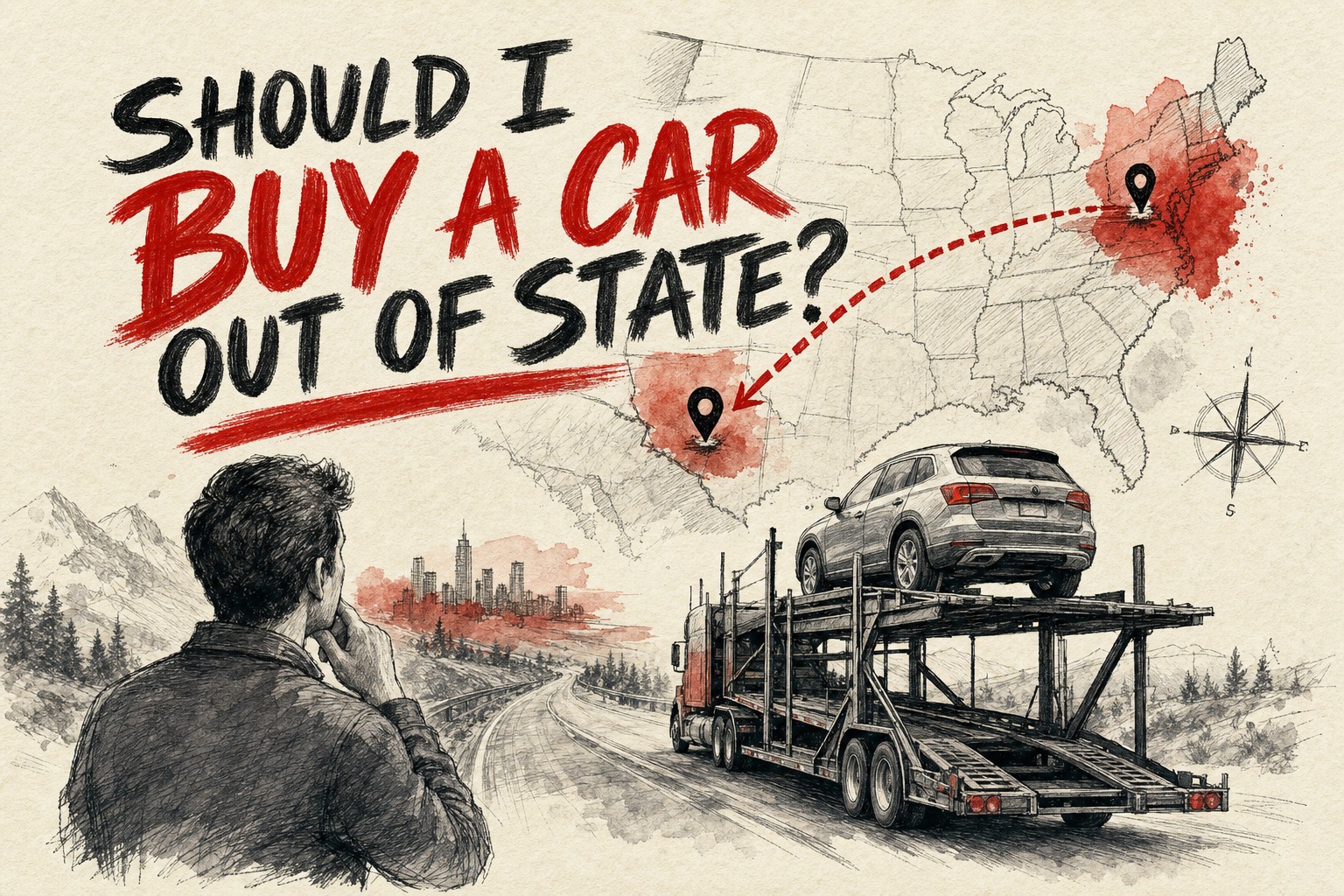
Answering: Should I Buy a Car Out of State?
Buying a car out of state is worth doing when the delivered, titled and registered total comes in under your best local out-the-door price, and it usually pays through selection rather than through a headline discount. The tax follows the state where you register the vehicle rather than the state where you hand over the money, so a Texas buyer still owes 6.25 percent motor vehicle sales and use tax, less any credit allowed for qualifying tax paid to the selling state, and when the seller is not licensed in Texas the title, the registration and the tax all fall due within 30 calendar days of the purchase date. Based on Rolo Rides founder Andrew Eder's fully remote practice, which has served clients in nine states and works anywhere in the United States, the wider search is usually the right call for one plain reason: the exact car you specified is rarely sitting on the closest lot.
If you are reading this with a browser full of listings from three states, the problem is probably not the money. You can buy the car. What you cannot buy back is the four evenings and two Saturdays it takes to chase inventory across state lines, work out which listings are real, verify a vehicle you cannot walk up to, and then referee the paperwork between two states' systems afterward. Resenting that is rational, and it is the actual cost you are weighing.
The reality is that a remote purchase adds three costs to budget for that a local one usually does not: getting the car home, inspecting a vehicle nobody on your side has stood next to, and moving a title between two states. Those costs are knowable in advance, and together they set the bar the out-of-state deal has to clear. When the price gap is wide or the specification is genuinely scarce near you, the bar is easy to clear. When you are chasing a few hundred dollars on a common model, it is not.
This guide covers when a wider search actually pays, what the tax, title and registration mechanics look like with Texas as the worked example, and the risk controls that keep a remote purchase from turning into an expensive lesson.
Key Insights
- Tax follows your registration state, not the seller's, so widening the search rarely changes what you owe the tax office.
- A Texas buyer pays 6.25 percent through the county tax assessor-collector, less any credit allowed for qualifying tax paid to the selling state.
- When the seller is not licensed in Texas, the title, the registration and the tax are all due within 30 calendar days of the purchase.
- Georgia charges most qualifying vehicles a one-time title ad valorem tax of 7 percent of fair market value instead, which is exactly why your own state's rules govern the math.
- The real return on a wider search is selection, and the real risk is money moving before the car and the title are verified.
Keep reading for the complete guide.
Table of Contents
- Key Insights
- When a Wider Search Actually Pays
- Tax, Title, and Registration: How the Mechanics Work
- The Risk Controls a Remote Purchase Requires
- Frequently Asked Questions
- Want to Learn More?
- Citations
When a Wider Search Actually Pays
Most buyers compare the wrong two numbers. They put a local sticker price next to a remote sticker price, see a gap, and treat the gap as savings. The comparison that decides this is your best local out-the-door total against the remote car's delivered, titled and registered total. Transport, the inspection you will pay for in another city, and the fees that land when the car reaches your county all belong on the remote side of the ledger. Ask both sellers for an out-the-door number in writing before you compare anything, because a quote without fees in it is not a price. Our guide on what hidden fees dealerships actually charge covers what belongs in that number and what does not.
The return on a wider search usually shows up in selection first. Trim levels, option packages, colors, mileage bands and certified pre-owned coverage are not spread evenly across the country. The configuration that three local dealers cannot find, or will only order for you, may be sitting in stock four states away because that market ordered differently. For a buyer who has already decided exactly what they want, that is the difference between the car and a compromise you look at every morning for six years.
Price differences are real but lumpy. A model that moves slowly in one region gets priced to move there, and a dealer sitting on a car nobody local wants has a reason to talk that the dealer with three buyers circling does not. That is also where your bargaining position improves. When ten or more dealerships are in the same conversation about the same specification, the closest one loses its monopoly on your business, which is precisely why Dealer Reputation and Sourcing is a named dimension of the Buying Phase rather than an afterthought.
Set your break-even before you start looking, not after you have found a car you like:
- Write down your best local out-the-door number first, so there is something honest to beat.
- Get the transport quote for your actual route before you call the price gap a saving.
- Add the pre-purchase inspection and a contingency for what the photographs did not show.
- Decide the dollar threshold that makes a remote deal worth doing, and hold it.
Run that arithmetic once and the decision stops being a matter of nerve. Either the remote car clears your threshold with the inspection and the transport quote already inside the number, or it does not, and a local car you can drive today wins on the merits.
Tax, Title, and Registration: How the Mechanics Work
The single most useful rule in this whole subject is that motor vehicle tax follows the state where you register the car, not the state where the seller stands. Crossing a state line to buy does not move you into that state's tax regime, and a low-tax seller's state is not a discount. In Texas, the Comptroller sets the motor vehicle sales tax at 6.25 percent, and title transfers and tax collection run through your local county tax assessor-collector rather than through the seller. Some out-of-state sellers do collect tax at the sale, and whether that reduces what you owe at home depends on your own state's credit rules, so get the treatment in writing before you agree to anything.
The Texas deadlines are tight enough to plan around. The state requires the vehicle to be titled in your name within 30 days of the date of sale to avoid delinquent transfer penalties, and registered within 30 days of the vehicle being brought into Texas. When the seller is not licensed in Texas, which describes most out-of-state purchases, the buyer carries the whole obligation: titling, registering and paying the tax at the county tax assessor-collector within 30 calendar days of the purchase date. For private-party purchases and for out-of-state vehicles brought in for Texas use, the taxable amount is not simply whatever the bill of sale says, because the state compares it against the vehicle's standard presumptive value or a certified appraisal.
The fees are modest and worth knowing in advance. Texas lists a base registration fee of $50.75 for passenger vehicles and light trucks, a title application fee of $28 or $33 depending on the county, local county fees of up to $31.50, a state inspection portion of up to $30.75, a $1 insurance verification fee, and a $4.75 processing and handling fee, with county and vehicle-specific charges varying on top. Bring the out-of-state title or other ownership evidence, proof of liability insurance meeting Texas minimums, a completed Form 130-U, and proof of sales tax payment. In the 17 counties that require emissions testing, which include Travis and Williamson in the Austin area, the car needs a passing emissions inspection before it can be registered.
Now the part generic advice gets wrong: those are Texas numbers, and your own state governs your purchase. Georgia does not charge a motor vehicle sales tax in the Texas sense at all. For most qualifying vehicles it charges a one-time title ad valorem tax of 7 percent of fair market value when the vehicle is titled, which replaced both sales tax and the annual ad valorem tax, with new residents generally paying 3 percent and stated exceptions applying. Whether tax you paid to the selling state is credited against what you owe at home depends on the state pair, the transaction and your documentation, so ask your county tax office or your state's revenue department rather than assuming either way.
- Confirm your own state's rate, deadline and inspection requirement before you commit.
- Ask the selling dealer in writing which taxes and fees they will collect and which they will leave to you.
- Keep every tax receipt from the selling state, because the credit question turns on documentation.
Getting the car home is its own decision. Driving it back means the selling state's temporary tag rules apply, so confirm what the dealer can issue and how long it lasts before you book a flight. Texas shows the shape of that category on its own side, where a 30-day permit costs $25 plus a $4.75 processing fee for qualifying vehicles under 10,000 pounds and a vehicle transit permit is free for five calendar days when the seller keeps the plates. Shipping removes the trip and the mileage, and it prices as a route-specific quote rather than a national average, so get the number for your actual origin and destination before you treat any of this as settled. Our complete car buying checklist tracks the sequence so nothing gets skipped when the pieces are moving in three places at once.
The Risk Controls a Remote Purchase Requires
Every risk in a remote purchase comes down to one question: what has anybody on your side actually verified before your money moved? Money discipline comes first. Do not wire funds for a vehicle nobody on your side has seen, keep any deposit small, documented and refundable in writing, and pay in a way that leaves you recourse. The oldest pressure move in a distance sale is urgency, a second buyer who supposedly appeared this morning, and urgency is the only reason anyone ever needs you to skip a step.
Second, inspect the car through someone who works for you. An independent pre-purchase inspection by a mechanic in the seller's city, written up and tied to the VIN, is the closest thing to standing in the lot yourself, and it is the spend that removes the most risk for the least money. A vehicle history report tells you what was reported; a mechanic tells you what the brakes, the tires, the fluids and the panel gaps look like today. It narrows the risk rather than eliminating it, since no inspection catches an intermittent fault or settles the title question. Our guide on whether you need a pre-purchase inspection when buying a used car makes the case in detail.
Third, treat the title as a deliverable with a date on it. Ask whether there is a lien and who pays it off, whether the state issues paper or electronic titles, who mails the title and when, and what the seller does if the car arrives first. A car sitting in your driveway that you cannot register is a common way a good remote deal turns sour. Vet the transport the same way. Ask which company will physically haul the car rather than only the one taking your booking, get its USDOT number and a current certificate of insurance, and make sure the bill of lading records the car's condition with photographs at pickup and at delivery.
- Order the inspection before any money moves, not after the deposit.
- Get the out-the-door price, the title timeline and the delivery window in writing.
- Photograph the vehicle at pickup and delivery, or have whoever receives it do it for you.
- Confirm your insurance covers the car from the moment it changes hands, not from the moment it arrives.
That is a great deal of coordination for someone whose actual complaint was a shortage of time. Handing it to an advocate is the alternative: Andrew contacts 10 or more dealerships per engagement, runs the specification and the numbers, and brings back one decision instead of a spreadsheet. Most engagements close within 48 hours, typical client time involvement is 30 minutes to an hour by phone, and the fee is a flat $999 paid upfront with no compensation accepted from any dealership. The process is entirely remote, has served clients in nine states, and works anywhere in the United States, which is the whole point when the right car is in Ohio and you are not. Our guide on how to negotiate a car price without going to the dealership walks through the same method at shorter range.
A wider search is a good instinct. It only becomes a good purchase when the tax, the title, the inspection and the transport are handled with the same care as the negotiation, which is exactly the work a flat-fee advocate takes off your calendar.
Frequently Asked Questions
Q: Should I buy a car out of state?
A: Buy out of state when the delivered, titled and registered total beats your best local out-the-door price, which most often happens when the exact specification you want is scarce near you. Tax follows the state where you register the car rather than the state where you buy it, so a Texas buyer owes 6.25 percent motor vehicle sales and use tax, less any credit allowed for qualifying tax paid to the selling state, and when the seller is not licensed in Texas the title, the registration and the tax are all due within 30 calendar days of the purchase date. Your own state sets its own rate, deadlines and inspection rules, so confirm those before you commit.
Q: Should I use a car-buying advocate for an out-of-state purchase?
A: It helps most when the search spans several states, which is exactly where the hours pile up. An advocate works only for you, contacts 10 or more dealerships per engagement, verifies the vehicle and the out-the-door numbers before any money moves, and negotiates without you sitting in a showroom. Rolo Rides does this for a flat $999, entirely remotely, having served clients in nine states with a process that works anywhere in the United States.
Q: Do I pay sales tax where I buy the car or where I register it?
A: You pay in the state where you register the vehicle. Texas charges 6.25 percent through the county tax assessor-collector, and when the seller is not licensed in Texas the buyer must title, register and pay within 30 calendar days of the purchase date. Other states run different systems: Georgia charges most qualifying vehicles a one-time title ad valorem tax of 7 percent of fair market value when the vehicle is titled. Whether tax paid to the selling state is credited depends on the state pair and your documentation, so ask your county tax office.
Q: What is the first step if I want help buying a car out of state?
A: Book a free discovery call. You will talk through the specification, the budget and where the car needs to end up, and you will know quickly whether a flat-fee advocate search fits. From there the Shopping Phase diagnosis locks the requirements before any dealership is contacted, most engagements close within 48 hours, and typical client time involvement is 30 minutes to an hour by phone.
Want to Learn More?
Andrew spent five years inside four dealerships before he started running the process for buyers instead, and the purchases that cross state lines are where that background earns its keep. If you want a former insider handling the paperwork trail as carefully as the price, he is easy to reach.
Citations
- "Out-of-State and Foreign Vehicles," Texas Department of Motor Vehicles. Source for the Texas deadlines and fees in this article: title within 30 days of the date of sale, registration within 30 days of bringing the vehicle to Texas, the $50.75 base registration fee, the $28 or $33 title fee, county fees up to $31.50, the state inspection portion up to $30.75, the $1 insurance verification fee, the $4.75 processing fee, the required documents, and the 17 counties including Travis and Williamson where an emissions inspection is required. https://www.txdmv.gov/motorists/buying-or-selling-a-vehicle/out-of-state-and-foreign-vehicles
- "Motor Vehicle Tax Guide: Motor Vehicle Sales Tax," Texas Comptroller of Public Accounts. Confirms that out-of-state purchases brought into Texas for Texas use are compared against standard presumptive value or a certified appraisal, and that a buyer purchasing from a seller not licensed in Texas must title, register and pay the tax to the county tax assessor-collector within 30 calendar days. https://comptroller.texas.gov/taxes/publications/96-254/mv-sales.php
- "Temporary Permits," Texas Department of Motor Vehicles. Source for the permits that let a vehicle be operated legally while permanent registration is pending, including the $25 thirty-day permit plus the $4.75 processing fee and the free five-day vehicle transit permit. https://www.txdmv.gov/motorists/register-your-vehicle/temporary-permits
- "Vehicle Taxes: Title Ad Valorem Tax (TAVT) and Annual Ad Valorem Tax," Georgia Department of Revenue. The counter-example showing that state mechanics differ rather than scale: Georgia's one-time TAVT is 7 percent of fair market value paid at titling, it replaced sales tax and annual ad valorem tax, and new residents pay 3 percent. https://dor.georgia.gov/motor-vehicles/vehicle-registration-license-plates/vehicle-taxes-title-ad-valorem-tax-tavt-and
If you'd like to learn more, visit our how it works page to see how a flat-fee advocate search runs from the first call to the keys in your hand.
Book a short, no-pressure call and Andrew will tell you plainly whether the car you want is worth crossing a state line for, then run the search and the negotiation if it is. It is a flat $999 for the whole engagement, entirely remote, with clients served in nine states and a process that works anywhere in the United States. The widest search only helps when someone has the time to run it properly, and that is the part you can hand over.
Shopping across state lines? Andrew works with buyers across the country through our nationwide car buying service.
Related Reading

About the Author
Andrew Eder is the founder of Rolo Rides, a flat-fee car buying advocacy service based in Austin, Texas. Before switching sides to represent buyers, Andrew spent five years inside four dealerships, including Honda, Mazda, and Lexus, where he worked in sales and managed the finance office. That experience gave him direct insight into how vehicles are priced, how interest rates are marked up, and how the finance office generates profit most buyers never see. Andrew holds a degree in Electrical Engineering from Milwaukee School of Engineering. He has facilitated over 1,000 vehicle transactions across 9 states and built Rolo Rides on a simple principle: charge the buyer a flat fee, accept zero compensation from the dealership, and protect every part of the deal.