
Should I Factory Order a Car or Buy From Dealer Stock?
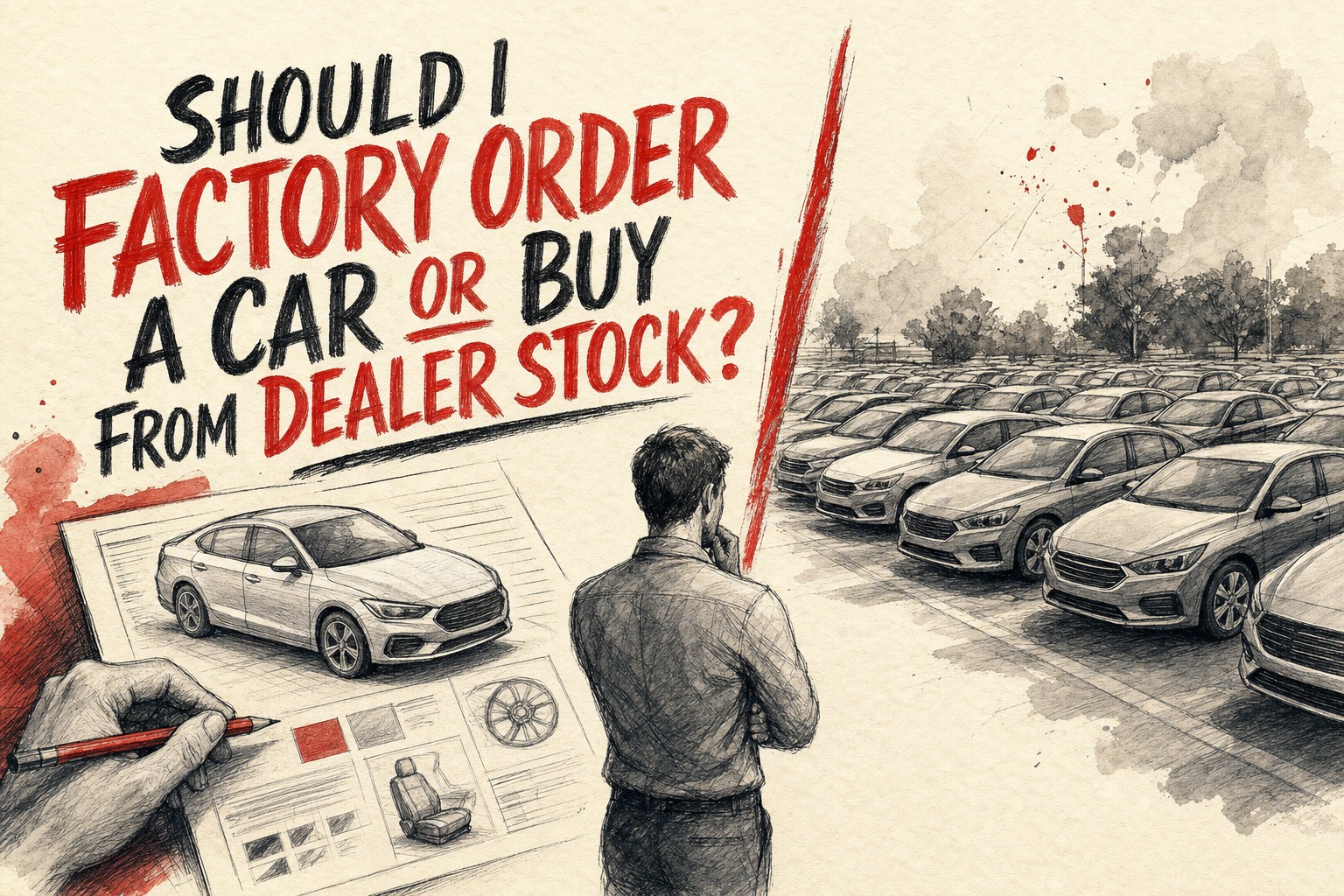
Answering: Should I Factory Order a Car or Buy From Dealer Stock?
Factory order the car when the exact trim, color, and option combination genuinely does not exist within reach, and buy from dealer stock when a built car already matches your specification closely enough that the compromise costs less than the wait. That is the whole decision, and it turns on two numbers you can actually put a value on: what the missing options are worth to you, and what the current discount on a car sitting on a lot is worth against a build that has not been scheduled yet. Based on Rolo Rides founder Andrew Eder's five years working inside four dealerships, the buyers who get this wrong are usually the ones who never priced the compromise, so they either settle for a car they will notice being wrong every morning, or they wait months for a build that a wider search would have found already made.
If you are the buyer who cares about the specification, you already know the feeling of being handled. You ask for a particular package in a particular color, and the answer comes back as a nudge toward whatever is on the lot this week, usually with the reassurance that you will not miss what you did not order. You will. That is why you asked.
The reality is that neither route is automatically cheaper or automatically safer. A factory order lets you specify the car instead of inheriting somebody else's configuration, but it also hands the dealership a longer stretch of time in which the price, the incentives, and the paperwork can move. A car in stock can be priced today, rebate program and fees included, on a written quote for that exact vehicle, but it comes as built, including whatever the dealership added to it before you arrived.
This guide covers how a factory order actually works, when a car already sitting on a lot is the better buy, and when ordering wins and how to lock the deal down before anyone submits it to the factory.
Key Insights
- A factory order is placed through a franchised dealer rather than the manufacturer, and it depends on that dealer holding production allocation for the model and trim you want.
- A deposit receipt is not a price guarantee: Consumer Reports reports that with a deposit alone the buyer has no signed contract and pays whatever the price is when the car arrives, while a purchase order can bind the dealership.
- Deposit refundability is whatever the written terms say it is, per Georgia's Attorney General consumer protection division, so make it a negotiated line rather than a handshake.
- Dealer stock wins on timing and on incentives you can confirm today; ordering wins when the exact specification matters more than the calendar.
Keep reading for the complete guide.
Table of Contents
- Key Insights
- How Factory Ordering Actually Works
- When Dealer Stock Is the Better Buy
- When Ordering Wins, and How to Protect the Order
- Frequently Asked Questions
- Want to Learn More?
- Citations
How Factory Ordering Actually Works
The first thing to understand is that you are not ordering from the manufacturer. On a franchised brand, you configure the car you want and a dealership verifies the build and submits it to the factory on your behalf, so the price, the fees, the deposit, and the treatment of manufacturer incentives are all dealership negotiations that happen before the car exists.
The second thing is allocation. At the brands that work this way, the factory assigns each dealership a share of production, often down to model and trim, and a dealership holding allocation for the car you want can usually schedule your build sooner than one waiting for its next tranche. Allocation systems differ by manufacturer, and some brands do not take retail orders on every model at all, which is exactly why this is worth asking out loud rather than assuming: does this store currently have allocation for that model and that trim, and if not, what is the realistic path for the order? A dealership without allocation can still take your deposit while the order waits, so ask for the order number, its priority, and its current status in writing rather than a verbal reassurance.
Then there is the deposit, which is where most order disputes start. Georgia's Attorney General consumer protection division puts it plainly: whether a deposit is refundable or non-refundable depends on what is written in a contract, on a receipt, or posted at the dealership, and the division's standing advice is to obtain a written document stating the purpose of the payment and the circumstances under which you are entitled to a partial or full refund. Treat it as a negotiated term with its own sentence in writing, and keep it separate from the money you intend to put down at delivery. Our guide on how much you should put down on a car covers that second number.
The most expensive misunderstanding is what the paperwork actually protects. Consumer Reports, reporting on ordered vehicles whose prices moved before delivery, describes the distinction bluntly: with a deposit, the final price is not carved in stone, so if the price changes before the dealer gets the car, the buyer has no signed contract and has to pay whatever the price is at that time, whereas a purchase order can be a binding contract. During the supply-constrained market, the same reporting documented dealers adding markups of more than $10,000 to already-ordered vehicles. Washington's Attorney General adds the rules that make this stick: there is no three-day right of cancellation on a vehicle purchase or lease contract, all verbal promises and representations should be put in writing, and you should never sign a contract with blank spaces.
What is negotiable before a build is submitted is more than most buyers realize:
- The selling price and the documentation fee, settled as one out-the-door number rather than a discount off a sticker that does not exist yet.
- Whether any dealer-installed accessories may be added to the car when it lands, which is the clause that keeps an ordered vehicle the car you specified. Confirm at the same time which packages are mandatory on that trim and what arrives as a port-installed item, because an order narrows your equipment list without erasing the manufacturer's own bundling.
- Which manufacturer incentive applies, and what happens if the program changes between the order and the delivery.
- The deposit terms, including the exact circumstances in which it comes back to you.
Wait times are the one thing nobody can promise you, because they vary by brand, by model, and by where your build lands in the production schedule. Ask for the dealership's current estimate in writing and hold it as an estimate, not a date.
When Dealer Stock Is the Better Buy
A car that already exists wins more often than order-minded buyers expect, and the clearest case is time. If a lease is ending, a commute starts in three weeks, or the household is down to one car, the specification argument loses to the calendar, and the honest move is to widen the search radius rather than to wait for a build.
The second case is the model-year changeover. A dealership carries the cost of every unit sitting on its lot, and an outgoing model year is a unit it would like to stop carrying. That pressure is real and it is seasonal, and where inventory on a model is deep it is why the same trim can land meaningfully cheaper as built stock than as a future order.
The third case is incentives, which behave differently from discounts. Consumer Reports notes that rebates come directly from the manufacturer regardless of the price you agree to at a dealership, which means the rebate and the negotiated discount are two separate conversations and a salesperson should never be allowed to substitute one for the other. The practical consequence for this decision is that the incentive on a specific in-stock vehicle can be confirmed in writing on the day you ask, subject to that program's own eligibility rules and expiry date, while the incentive that will apply to a car built later is a question about a future program. That is not a reason to avoid ordering. It is a reason to get the answer in writing before the order goes in.
What you accept in exchange for that certainty is the car as somebody else configured it, and this is where the insider mechanics matter. Lot units are frequently presented already carrying dealer-installed extras such as protective paint or fabric coatings, nitrogen-filled tires, rust proofing, pinstripes, and alarms, with service contracts offered alongside them at the desk rather than fitted to the car. Consumer Reports names extended warranties, nitrogen-filled tires, and rust protection among the products dealerships push at this point, and quotes a consumer attorney describing what happens when a buyer is pushed to take unwanted add-ons after a price has been quoted, calling it a switched price and, in most places, an unfair trade practice. Washington's Attorney General is equally direct that optional additions to a purchase, including service contracts, add-ons such as spoilers, vehicle protection options like protective paint coatings, and credit insurance, may be negotiated. So buying from stock is two exercises rather than one: finding the closest specification, then subtracting the equipment you did not choose from the price, which starts with asking for an itemized buyer's order instead of a single bottom-line number. Our breakdown of what hidden fees dealerships actually charge covers the rest of what shows up on that line of the worksheet.
Then price the compromise honestly. Put a dollar figure on the color you did not want, the package you will miss, and the trim step you are skipping. If the built car is a few thousand dollars less delivered and the missing options are worth less than that to you over the years you plan to keep it, stock wins on the arithmetic, and the specification argument was never really about money.
When Ordering Wins, and How to Protect the Order
Ordering wins in three situations. The first is when the exact combination genuinely does not exist in a searchable radius, which happens most often with low-volume trims, manual transmissions, specific interior colors, and option packages that dealerships do not speculatively stock because they are harder to sell to a walk-in. The second is when the combination exists only on cars carrying extras you did not choose and the dealership will not remove or discount them, in which case those extras are simply part of the out-the-door price you are comparing. The third is when you plan to keep the car a long time, because the options you will notice daily are worth more across ten years than they are on a resale spreadsheet.
What separates a good order from an expensive one is the search that comes before it. The Buying Phase at Rolo Rides starts with Dealer Reputation and Sourcing, which in practice means contacting more than ten dealerships per engagement, and for a specification-driven buyer that search does three jobs at once: it finds the exact car if it already exists somewhere as built or in transit, it finds which stores actually hold allocation for the trim you want, and it finds the dealership willing to place the order at a fair price rather than the one that treats a custom build as a reason to hold firm on price. Andrew spent five years inside four dealerships, including managing the finance office at a Honda store, and has been involved in more than 1,000 vehicle transactions across sales, finance management, and buyer representation, which is the background that makes the allocation question answerable rather than theoretical.
Before any of that, the Shopping Phase runs a six-dimension diagnosis covering Needs, Wants, Budget Reality, Total Cost of Ownership, Resale and Depreciation, and Pressure-Free Evaluation. For the buyer who wants an exact car, the useful work is in the first two and the fifth: separating what you actually need from what you want, then pricing the wants, and checking which specification choices hold value and which quietly cost you at trade-in.
Then lock the deal before the order is submitted, not after:
- Get a signed purchase order with the out-the-door price, not a deposit receipt.
- Put the deposit terms in writing, including exactly when it is refundable.
- State that no dealer-installed accessories will be added to the vehicle.
- Document which manufacturer incentive applies and what happens if the program changes before delivery.
- Work the full checklist: our complete car buying checklist keeps anything from being left to the delivery appointment.
Across historical client outcomes, working a new-car purchase this way has averaged around ten percent off MSRP, and results vary by market, model, and how much inventory exists. If you would rather run the negotiation without ever standing in a showroom, our guide on how to negotiate a car price without going to the dealership walks through that approach.
The decision between an order and a lot car is not a matter of taste. It is a search question and a paperwork question, and both are answerable before you commit a dollar.
Frequently Asked Questions
Q: Should I factory order a car or buy from dealer stock?
A: Factory order when the exact trim, color, and options do not exist within a searchable radius, or exist only on cars loaded with dealer-installed extras you did not choose. Buy from dealer stock when you need the car soon, when an outgoing model year carries real discount pressure, or when a built car matches your specification closely enough that the compromise costs less than the wait. Price the compromise in dollars before you decide, because that comparison settles most of these cases.
Q: Can a dealership change the price of a car I factory ordered before delivery?
A: It depends on what you signed. Consumer Reports reports that with a deposit alone the price is not carved in stone, so a buyer without a signed contract pays whatever the price is when the car arrives, while a purchase order can be a binding contract. Get a signed purchase order with the out-the-door price before the order is submitted, and put the deposit terms in writing too, since Georgia's Attorney General consumer protection division notes that refundability depends on what the contract, receipt, or posted policy actually says.
Q: Should I use a car-buying advocate if I want an exact trim and color?
A: It helps most when the search is specification-driven, which is exactly what an order-versus-stock decision is. An advocate works only for you, searches widely for a built or in-transit car that already matches, checks which dealerships hold allocation for that trim, and negotiates the price, fees, and add-on terms before anything is signed. Rolo Rides does this for a flat $999 fee, fully remote, for buyers anywhere in the country.
Q: What is the first step if I want help deciding between an order and a lot car?
A: Book a free discovery call. You will talk through the exact specification you want, your timing, and your budget, and you will know quickly whether the car already exists somewhere or is worth ordering. From there, the Shopping Phase diagnosis locks the requirements before any dealership contact happens.
Want to Learn More?
Andrew spent five years inside four dealerships before switching to the buyer's side, and he has been involved in more than 1,000 vehicle transactions across sales, finance management, and buyer representation. Today he runs searches for buyers in Austin and across the country, fully remote, and the specification-driven searches are the ones where knowing how allocation and add-ons really work pays for itself.
Citations
- "Can a Dealer Change the Price of a Car You Ordered When You Take Delivery?" Consumer Reports, August 14, 2022. Source for the deposit-versus-purchase-order distinction quoted here, for the markups of more than $10,000 added to already-ordered vehicles during the supply-constrained market, and for the consumer attorney's description of forced add-ons as a switched price. https://www.consumerreports.org/cars/car-pricing-negotiation/can-dealership-change-price-of-ordered-car-before-delivery-a7159840038/
- "Dealer won't refund my deposit," Consumer Ed, Georgia Attorney General's Consumer Protection Division. State consumer-protection guidance that whether a deposit is refundable depends on what is written in a contract, on a receipt, or posted at the dealership, and that buyers should obtain written documentation stating the purpose of the payment and the refund circumstances before handing over money. https://consumered.georgia.gov/ask-ed/2016-03-15/dealer-wont-refund-my-deposit
- "Buying a Car," Washington State Office of the Attorney General. State consumer-protection guidance cited for the absence of a three-day right of cancellation on vehicle purchase and lease contracts, the instruction to get all verbal promises in writing and never sign a contract with blank spaces, and the point that optional additions including service contracts and protective coatings may be negotiated. https://www.atg.wa.gov/buying-car
- "Expert Tips for Negotiating the Best New Car Price," Consumer Reports, updated March 24, 2026. Source for the point that rebates come directly from the manufacturer regardless of the price you agree to at a dealership, and for the out-the-door price and competing-quotes approach used throughout this guide. https://www.consumerreports.org/cars/car-pricing-negotiation/how-to-negotiate-a-new-car-price-effectively-a8596856299/
If you'd like to learn more, visit our how it works page to see how a flat-fee advocate search runs from first call to keys in hand.
Book a short, no-pressure call and Andrew will tell you whether the car you have specified already exists somewhere in the country or is genuinely worth ordering, then negotiate it on your side only. It is a flat $999 for the whole search and negotiation, whether you are in Austin or anywhere else. The point of caring about the specification is that you get to keep caring about it, without paying a premium for the privilege.
Shopping from outside Central Texas? Andrew runs specification searches for buyers across the country through our nationwide car buying service.
Related Reading

About the Author
Andrew Eder is the founder of Rolo Rides, a flat-fee car buying advocacy service based in Austin, Texas. Before switching sides to represent buyers, Andrew spent five years inside four dealerships, including Honda, Mazda, and Lexus, where he worked in sales and managed the finance office. That experience gave him direct insight into how vehicles are priced, how interest rates are marked up, and how the finance office generates profit most buyers never see. Andrew holds a degree in Electrical Engineering from Milwaukee School of Engineering. He has facilitated over 1,000 vehicle transactions across 9 states and built Rolo Rides on a simple principle: charge the buyer a flat fee, accept zero compensation from the dealership, and protect every part of the deal.