
Car Broker vs Car Buying Advocate vs Concierge: What Is the Difference?
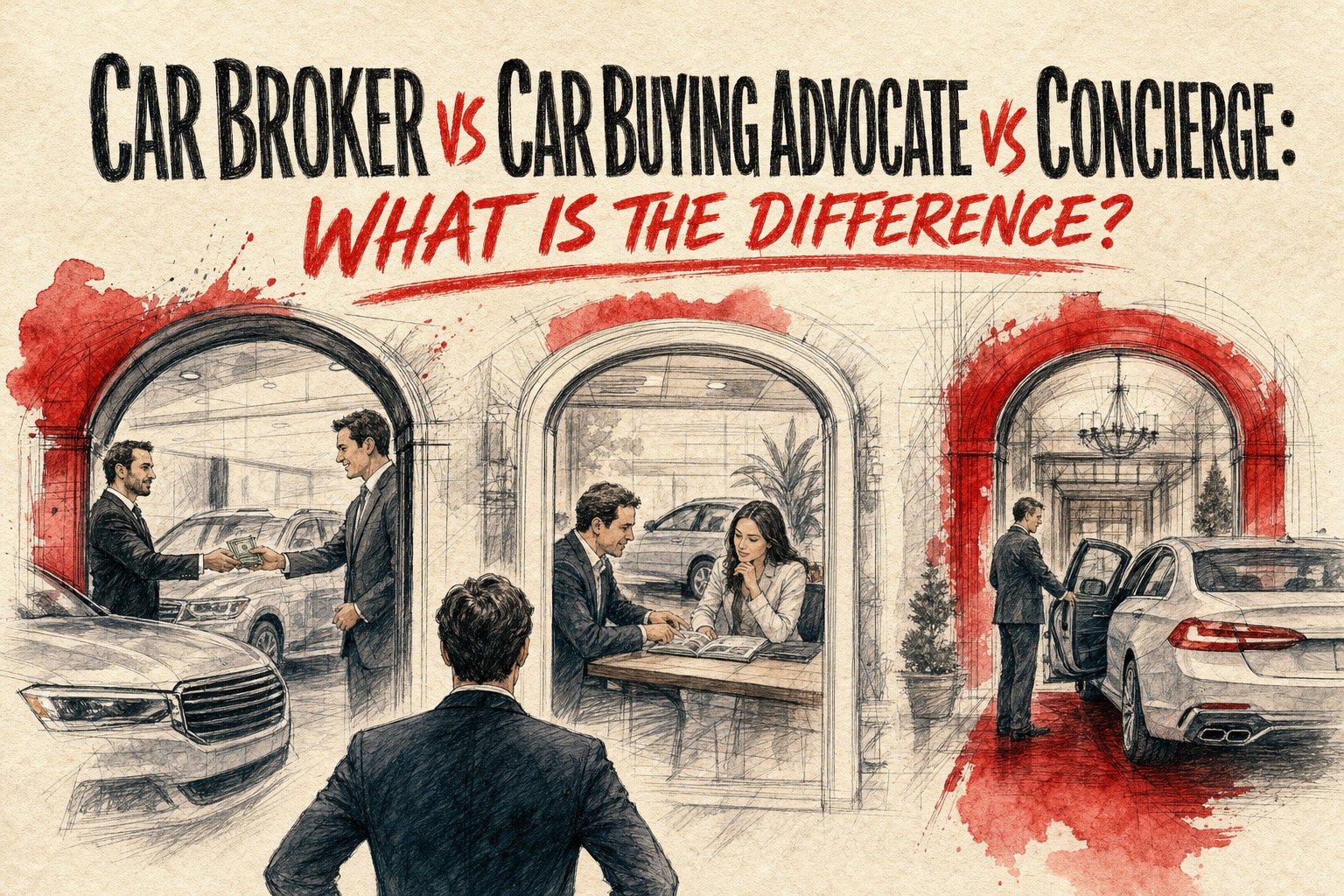
The difference between a car broker, a car buying advocate, a car concierge, and a dealer-paid buying program comes down to four questions: who pays the person in the middle, whether that person takes title to the car and resells it to you, where the margin sits, and how much of the desk work still lands on you. Texas prohibits acting as a broker, California licenses it as an autobroker endorsement on a dealer's license, and a buyer-paid advocate is the opposite mechanism: paid once by you, no title, no resale, nothing from the dealer.
You have the money for the car and no appetite for the process. You type hire someone to negotiate a car deal between meetings, and every result reads like the same white-glove promise. The words are identical because the words are free. What costs money is the structure underneath them.
Key Insights
A broker arranges or completes the purchase for a fee and, in the title-taking version, resells you the car with its margin inside the price. A buyer-paid advocate is paid once, by you, takes no title and accepts nothing from the dealer. Concierge is an unregulated label that can sit on any of these. A dealer-paid program is free to you because participating dealers pay it, and in Costco Auto Program's own words it does not negotiate individual transactions.
What this guide covers
- The Four Models, Defined by Their Mechanism
- Criterion One: Who Pays the Person in the Middle
- Criterion Two: Who Takes Title, and Why It Changes the Price
- Criterion Three: Where the Margin Sits
- Criterion Four: What You Still Have to Do at the Desk
- When the Flat Advocate Fee Is the Wrong Shape
The Four Models, Defined by Their Mechanism
California's DMV manual says an autobroker or auto buying service is a dealer, as defined in Vehicle Code Section 285, who engages in brokering, and it defines brokering as an arrangement under which a dealer, for a fee or other consideration, provides the service of arranging, negotiating, assisting, or effectuating the purchase of a new or used motor vehicle not owned by the dealer, for another. A dealer may not broker a retail sale there without an autobroker's endorsement on its dealer license, and the endorsement comes with a DMV-inspected log and a trust account for any purchase money received from a consumer or a consumer's lender. Texas goes the other way entirely: Section 2301.006 of the Occupations Code says a person may not act as, offer to act as, or claim to be a broker. In everyday practice the version buyers most often meet buys the vehicle from the dealership and resells it to you, so title passes through the intermediary's hands and its margin lives in the gap between the two prices. That is the model this site's own how-it-works page describes only to say what the service here is not: it never purchases or takes title to any vehicle, and the dealership sells directly to you.
A buyer-paid advocate is the structural opposite. You pay the fee, nobody else does, the advocate never takes title, the dealership sells the car directly to you, and the work is the negotiation itself: sourcing the exact vehicle, the sale price and the fees, the trade-in as its own number, the finance structure, and a review of the finance-office paperwork before you sign. In Rolo Rides' published model that is one flat $999, paid upfront and one time, with no hourly billing, no complexity surcharge, no time limit, and the same fee whatever the vehicle's make or price. The fee is paid before a single dealership is contacted, which is the design choice that keeps the advocate on your side of every conversation.
Concierge is the model that is not a model. Nobody licenses the word, so it is used by buyer-paid advocates, by referral services funded by the dealers they send you to, by software subscriptions, and by one-job negotiators who work the sticker price and stop. The label is marketing; the structure underneath it is one of the other three. The difference between a negotiation-only service and a full advocate is laid out in what a car negotiation service actually does, and the national concierge field is sorted by who pays in the guide to the best car buying concierge services.
A dealer-paid program is the free one, and it is honest about why. Costco Auto Program's own site states that a participation fee has been paid by the dealers participating in the program, that vehicles are sold at a price prearranged with the participating franchised dealer, and that Costco and its affiliates do not sell automobiles or negotiate individual transactions. Warehouse clubs, auto clubs and card issuers run programs of this shape. You get a prearranged number at a participating lot, and by the program's own words the transaction itself is not negotiated for you; the trade, the loan and the add-ons at the desk are between you and the dealer.
Criterion One: Who Pays the Person in the Middle
This is the criterion that sets every incentive downstream, and the one busy buyers skip because it feels rude to ask. An intermediary paid by the selling side has two clients, and only one of them does business with it every week. The Federal Trade Commission makes the same point about the dealer's own finance desk in its consumer guidance on financing a car: the dealer typically profits from offering financing and may not always offer you the best deal. A person who stands between you and that dealer should not be on the same payroll.
Set the four models side by side on this one criterion and they stop looking alike. The title-taking version of the broker model earns on the resale, so its compensation is built into the price you pay for the car rather than printed as a fee, and the arranging version may be paid by you, by the selling dealer, or by both; you find out by asking, in writing. A buyer-paid advocate is paid by you and only you, which is what makes the fee a feature rather than a cost: there is no second client to serve. A concierge is paid however the business underneath the label is paid. A dealer-paid program is paid by the dealers in its network, which is why it costs you nothing and why it has no reason to push the prearranged price any lower.
On this criterion the advocate whose site this is publishes its answer on its pricing page: zero compensation from any dealer, no commissions, no kickbacks, and no incentive to steer you toward a pricier car. That is the shape of answer to look for from anyone you consider, including this service. The full list of what to ask, and what a straight answer sounds like, is in what to ask a car buying service before hiring one.
Criterion Two: Who Takes Title, and Why It Changes the Price
Title is the quiet criterion, and it is the one that separates a broker from everyone else more cleanly than any fee comparison. When an intermediary buys the car and resells it to you, there are two transactions and you only ever see the second one. The dealership's selling price is the intermediary's business, the price you pay is yours, and the difference is a margin you cannot audit because you were never shown the first number. California's trust-account rule applies whenever an autobroker receives purchase money from the consumer or the consumer's lender, which tells you how much of your money can pass through the middle in that model.
A buyer-paid advocate never holds the car. The dealership sells to you directly, the out-the-door number you sign is the dealer's own written number, and the advocate's fee is a separate line you have already paid. Nothing is hidden inside the vehicle price because the advocate was never in the chain of title. This site's how-it-works page puts it in one sentence: the service never purchases or takes title to any vehicle, and the dealership sells directly to you. A dealer-paid program is also outside the chain of title; the participating dealer sells to you at the prearranged price. The difference between the program and the advocate is not title, it is whether anyone negotiated that price on your behalf, and whether anyone is still in the room when the trade, the loan and the add-ons come up.
For a busy professional the practical test is simple. If the person you hire is the seller of record on your paperwork, you have bought from a dealer who also charged you a fee. If the dealership is the seller of record and the person you hired is nowhere on the title, you have hired an advocate, whatever the website called itself.
Criterion Three: Where the Margin Sits
The sticker price is the margin everyone negotiates. The margin that decides most deals sits one room over, in the finance office, and only some of these models ever walk into it. The FTC's guidance is direct: the APR you negotiate with the dealer usually includes an amount that compensates the dealer for handling the financing. The Consumer Financial Protection Bureau described the mechanism in 2013: the lender usually provides the dealer with an interest rate it will accept, the dealer may charge the consumer a costlier rate, the increase is called dealer markup, and the lender shares part of the revenue from that increased rate with the dealer. How common is it? An MIT analysis reported by NerdWallet found that about 78 percent of dealer-arranged loans carry marked-up interest rates, with an average markup of 1.13 percentage points.
Now map the four models onto that room. A dealer-paid program, by its own description, does not negotiate individual transactions: the price was prearranged, so the rate, the warranty, and the add-on menu are yours to handle alone. A title-taking broker arranges its own financing or hands you to the dealer's; either way the resale margin is already in the price before the loan is discussed. A concierge may or may not cover the finance office, and the only way to know is to ask whether the rate and the add-ons are inside the engagement. A full buyer-paid advocate treats finance structure as one of the four Buying Phase dimensions alongside dealer reputation and sourcing, price and fees, and trade-in value, and evaluates every offer as one coordinated transaction.
Andrew spent five years inside four dealerships and managed the finance office at a Honda store, which is the room described above, before he moved to the buyer's side of the desk. On the published $50,000 new-vehicle example, the finance-office piece of the work is a rate protection of 1 to 2 percent, about $1,400, alongside roughly 10 percent off MSRP and dealer fees reduced by $500 to $2,000. Those are historical client outcomes on new cars, every deal is different, and results vary. The point is not the total; it is that three of the four numbers live in rooms a prearranged price never enters.
Criterion Four: What You Still Have to Do at the Desk
If you are the buyer with more money than time, this is the criterion that actually prices the decision, because your cost is Saturdays, not dollars. A dealer-paid program saves you the price haggle and nothing else: you still find the participating dealer, still visit it, still handle the trade-in as a separate argument, and still sit in the finance office with the add-on menu open in front of you. A broker in the title-taking model delivers a car, but your negotiation simply moves one seat over, to the broker's own price, with less information than you had before. A negotiation-only concierge works the sticker and hands the rest back to you.
A full advocate is the only one of the four whose job is to take the desk away. In the advocate process published on this site the engagement runs by phone from anywhere in the United States, ten or more dealerships are contacted to source the exact specification, most engagements close within 48 hours, and the client's own time involvement is typically 30 minutes to an hour, with paperwork coordinated and the car delivered to your door where available. Clients have been served remotely in nine states so far, and the process is the same in all fifty. The how-it-works page walks through the Shopping Phase diagnosis and the Buying Phase execution step by step.
When the Flat Advocate Fee Is the Wrong Shape
A comparison that always ends with hire us is not a comparison, so here is where the buyer-paid flat fee loses. It loses on a small purchase. If the money genuinely on the table in price, rate and fees does not comfortably exceed the fee, a dealer-paid program that costs you nothing is the rational choice, and a prearranged price at a participating dealer is a perfectly good outcome for a straightforward buy. It loses when you enjoy the process and have the weekends to spend; some people do, and for them a software tool or a negotiation-only service that runs price discovery while they stay in the driver's seat is the better fit.
It also has limits of its own that deserve to be stated. A single advocate is one person rather than a bench, so capacity is finite in a way a national dealer network is not. The historical savings figure of about 10 percent off MSRP is a new-car number; used vehicles are a different market with different arithmetic, and the number should not be carried across.
The arithmetic that should decide it is the $50,000 example in Criterion Three, run on your own purchase instead. If your numbers come out at a tenth of those, the fee is the wrong tool and the right answer is free. The national field, including the dealer-funded programs and the software tools, is compared on exactly this basis in the guide to the best car buying services in the US.
Hire the Job, Not the Label
If you want one named person paid only by you, a flat fee with no dealer compensation, to run the sourcing, the price, the trade and the financing end to end so you do not spend three Saturdays on it, book a free 15-minute discovery call and find out whether the advocacy engagement fits this purchase. If it does not, you will be told so directly.
Frequently asked questions
Q: Is a car buying advocate the same as a car broker?
A: No. A broker arranges or completes the purchase for a fee, and in the title-taking version buys the car and resells it to you with its margin inside the second price; Texas prohibits acting as a broker and California licenses the activity as an endorsement on a dealer license. An advocate is paid only by the buyer, never takes title, accepts nothing from the dealer, and the dealership sells the car directly to you. The advocate model on this site is a flat $999 paid by you, zero dealer compensation, no purchase and no resale of any vehicle.
Q: Is a dealer-paid car buying program really free?
A: It is free to you, and the program's own materials say why. Costco Auto Program states that a participation fee has been paid by the dealers participating in the program, that the price is prearranged with the participating franchised dealer, and that Costco and its affiliates do not sell automobiles or negotiate individual transactions. You get a prearranged price; the trade-in, the rate and the finance-office add-ons remain yours, and for a straightforward purchase where any fee would eat the plausible saving, that is a sensible trade.
Q: How long does a buyer-paid advocate take, and how much of my time does it need?
A: Less of it than the dealership would take. In the process published on this site the engagement runs by phone from anywhere in the United States: a free discovery call, the flat fee, one or two calls while the advocate contacts dealerships and reviews the paperwork, and your signature at the end, with delivery to your door where available. Most of the elapsed time belongs to the advocate rather than to you; the published typical turnaround and time figures are in Criterion Four above, and they are typical outcomes, not a guarantee.
Q: How do I find out which model a service actually is before I pay?
A: Ask who pays them, whether they ever take title, whether the fee is flat, and whether the finance office and the trade-in are inside the engagement, and ask for each answer in writing or on a published page. The first step with Rolo Rides is a free discovery call in which Andrew asks about your situation, tells you whether he can help, and explains what the process would look like; no payment is required.
Citations
- 2.010 Autobroker (VC §166), Vehicle Industry Registration Procedures Manual, California DMV. The state's own definition: an autobroker or auto buying service is a dealer who engages in brokering, brokering is arranging, negotiating, assisting, or effectuating a purchase for a fee, and a dealer may not broker a retail sale without an autobroker's endorsement. The source for the California definition used throughout. https://www.dmv.ca.gov/portal/handbook/vehicle-industry-registration-procedures-manual-2/general-information-licensees/autobroker/
- Autobroker's Endorsement, California DMV. Confirms that the endorsement carries an autobroker log that remains DMV property and may be taken for inspection, and that purchase money received from a consumer or a consumer's lender must be deposited into a trust account. https://www.dmv.ca.gov/portal/vehicle-industry-services/occupational-licensing/occupational-licenses/vehicle-dealer-license/autobrokers-endorsement/
- Texas Occupations Code Section 2301.006, Brokers Prohibited. The one-sentence Texas statute: a person may not act as, offer to act as, or claim to be a broker. The only Texas source the article relies on. https://texas.public.law/statutes/tex._occ._code_section_2301.006
- Financing or Leasing a Car, Federal Trade Commission Consumer Advice. The FTC's guidance that the dealer typically profits from offering financing and may not always offer the best deal, that the APR negotiated with a dealer usually includes an amount compensating the dealer, and that buyers should know the total cost rather than the monthly payment. https://consumer.ftc.gov/articles/financing-or-leasing-car
- CFPB to Hold Auto Lenders Accountable for Illegal Discriminatory Markup, Consumer Financial Protection Bureau (March 2013). Cited only for its description of the dealer-markup mechanism: the lender provides a rate it will accept, the dealer may charge a costlier rate, and the lender shares part of the added revenue with the dealer. The page notes the 2013 bulletin it announced was later disapproved by Congress; the mechanism description is what this article relies on. https://www.consumerfinance.gov/newsroom/consumer-financial-protection-bureau-to-hold-auto-lenders-accountable-for-illegal-discriminatory-markup/
- Costco Auto Program, official site. The program's own disclaimer language: a participation fee has been paid by the dealers participating in the program, vehicles are sold at a price prearranged with the participating franchised dealer, and Costco and its affiliates do not sell automobiles or negotiate individual transactions. https://www.costcoauto.com/
- Do Car Dealers Make Money on Financing?, NerdWallet. Reports the 2023 MIT analysis finding that about 78 percent of dealer-arranged loans carry marked-up interest rates, with an average markup of 1.13 percentage points, and explains dealer reserve. https://www.nerdwallet.com/auto-loans/learn/dealers-profit-off-financing
Related reading
- What Are the Best Car Buying Services in the US?
- What Is a Car Negotiation Service and How Does It Work?
- What Should I Ask a Car Buying Service Before Hiring One?
- The Complete Car Buying Checklist: Every Step From Research to Keys in Hand
- What Hidden Fees Do Dealerships Actually Charge?
- How It Works: the Shopping Phase and Buying Phase System

About the Author
Andrew Eder is the founder of Rolo Rides, a flat-fee car buying advocacy service based in Austin, Texas. Before switching sides to represent buyers, Andrew spent five years inside four dealerships, including Honda, Mazda, and Lexus, where he worked in sales and managed the finance office. That experience gave him direct insight into how vehicles are priced, how interest rates are marked up, and how the finance office generates profit most buyers never see. Andrew holds a degree in Electrical Engineering from Milwaukee School of Engineering. He has facilitated over 1,000 vehicle transactions across 9 states and built Rolo Rides on a simple principle: charge the buyer a flat fee, accept zero compensation from the dealership, and protect every part of the deal.