
How do I complete a trade-in remotely without having to drive to a dealership?
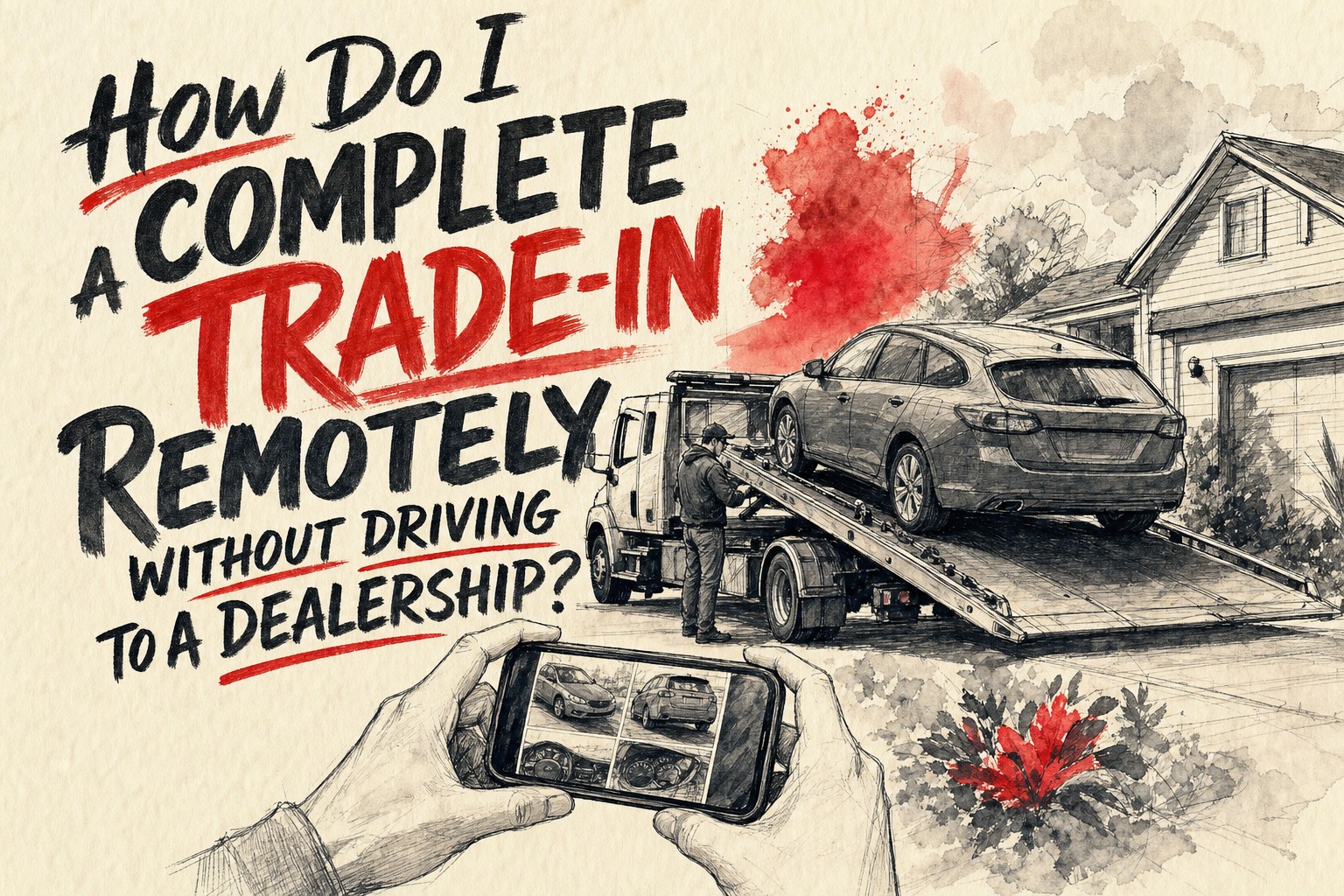
You complete a trade-in remotely in seven steps: treat the trade as its own transaction, get your lender's written payoff and work out your equity, build a photo and VIN packet, set a floor with an instant-offer service, shop that packet to several buyers for written numbers, close the title and lien paperwork by mail or electronic release, and hand the car over at pickup. Rolo Rides founder Andrew Eder spent five years inside four dealerships, including managing the finance office at a Honda store, and his Buying Phase runs Trade-in Value as its own dimension because the trade is where a remote deal goes soft.
A dealer values a trade near wholesale, because they recondition and resell it, and that is fair. What the lot takes away is time to hold several written numbers side by side before answering anyone. From your driveway you have that time.
Key Insights
A remote trade-in is arithmetic plus paperwork, both by email. Get the payoff quote before any offer arrives; offer minus payoff is the only number that matters. Photograph the car honestly; the pickup walk-around finds what photos hid. Use an instant-offer service as a floor and make the selling dealer beat it in writing. Keep the trade out of the purchase price and the monthly payment. Your state sets the lien-release and transfer clocks (Texas: 10 and 30 days).
What this guide covers
- Step 1: Make the Trade Its Own Transaction
- Step 2: Get the Payoff Quote and Run the Equity Math
- Step 3: Build the Remote Appraisal Packet
- Step 4: Set a Floor With Instant-Offer Services
- Step 5: Shop the Trade to Several Buyers in Writing
- Step 6: Close the Title and Lien Paperwork From Home
- Step 7: Hand the Car Over at Pickup or Shipping
- Where an Advocate Fits in a Remote Trade
Step 1: Make the Trade Its Own Transaction
A car deal has four moving numbers: the price of the car you are buying, the value of the car you are leaving, the cost of the money, and the monthly payment that results. The showroom method depends on you looking at the last one, because a few hundred dollars shaved off a trade disappears when it is spread across six years of payments. The remote method depends on you looking at the first two separately, in writing, before the third is discussed.
The Federal Trade Commission puts the order plainly: wait to discuss the possibility of a trade-in until after you have negotiated the best possible price for the new car, so the seller cannot adjust the sales price to make up for a generous trade-in offer. The Consumer Financial Protection Bureau adds that trade-in value is one of the things you negotiate, with estimates from several dealers compared the same way you would compare loan quotes. Neither agency says the trade has to happen where the purchase happens, and in practice it often should not.
The dealer selling you the next car is one bidder for your old one, not the only bidder, and the two conversations happen in separate emails. If the dealer's quote for the new car arrives with a trade figure already blended in, ask for it again as two lines. Our guide to getting the best trade-in value for your car covers why the blended version is the one you cannot check, and the tax treatment some states give a trade that is part of the same purchase.
- Agree the purchase price of the next car in writing before you mention the trade.
- Ask every buyer for the trade as its own written figure, never as a discount off the new car.
- Refuse to discuss anything in monthly-payment terms until every number is on the page.
- Treat the selling dealer as one of several bidders for your car.
Step 2: Get the Payoff Quote and Run the Equity Math
If there is a loan on the car, the payoff comes first. The CFPB is specific that the payoff amount is what you must pay to close the loan, and that it can differ from the balance on your statement because of how interest accrues and any unpaid fees or charges. Ask the lender for it in writing, with the date it is good through, because interest keeps running while you shop and a quote from last month is not a number anyone can settle on.
Now the arithmetic. If the best written offer is higher than the payoff, you have positive equity, and the CFPB's guidance is to pay off the existing loan before taking on a new one, checking first whether your loan carries a prepayment penalty. If the offer is lower than the payoff, you have negative equity. A dealer or lender may offer to roll that leftover balance into the new loan, and the CFPB says directly that this makes the new loan more expensive; the FTC adds that it may increase the amount you borrow, the length of the agreement, or the monthly payment.
Say the lender's written payoff is $14,200, good through the end of the month. An instant-offer service returns $13,100, one dealer offers $12,900 and another, after seeing the floor, $13,600. The best written number is $13,600, so $13,600 minus $14,200 leaves $600 of negative equity: that is the shortfall you pay in cash at closing or decline to carry into the next loan. Had the best offer been $15,000 instead, the same subtraction gives $800 of positive equity, which comes back to you as cash or as a down payment on the next car. The numbers are illustrative and yours will differ; the subtraction is the point, and it is the one piece of the trade you can check without anyone's help.
Write the equity figure down before a single offer arrives; everything that follows is measured against it. If the figure is negative, our guide on what to do if you owe more than your car is worth ranks the options by situation, and most of them are cheaper than carrying the shortfall into the next loan.
- Request a written payoff quote with its good-through date; do not use the statement balance.
- Offer minus payoff is your equity. Positive means pay the loan off at closing; negative means the shortfall has to go somewhere.
- If a dealer promises to pay off your negative equity, the CFPB's advice is to make sure that amount is not built into your new financing or final contract.
Step 3: Build the Remote Appraisal Packet
A remote appraisal is a number given on a packet. A lot appraisal is a number given on a walk-around, then revised in the manager's office. The packet is better for you, provided it is complete, because every buyer prices from the same information and none of them get to discover something the others did not.
The identifiers are the VIN, the current odometer reading, and the title status: a paper title in your hand, a lender holding it, or a state electronic record. The photographs should be taken in daylight on a clean car and cover each exterior corner, every wheel and tire, the full interior, the dashboard lit with the mileage visible, and a close-up of every chip, dent, scuff and stain. If the car has had paintwork or a windshield replacement, say so.
The condition report is where buyers decide whether to trust the rest of the packet. List what works, what does not, the tire tread, the service history you can document, the number of keys, and anything a mechanic has told you is coming. The temptation is to photograph around the damage. Do not. Every remote offer is conditional on the car matching the packet at pickup, so the number you protect by hiding a dent is a number you lose on the driveway in front of the truck. An honest packet gets a slightly lower opening figure and a closing figure that holds.
- VIN, odometer reading, title status, and lender name if there is a lien.
- A full set of daylight photographs including every blemish, not just the good angles.
- A written condition report with service records attached, the same version sent to every buyer.
Step 4: Set a Floor With Instant-Offer Services
Before any dealer sees the packet, get a written offer from one or two instant-offer services. Carvana and CarMax both quote online from a VIN or plate plus your answers about condition, and several large dealer groups run similar tools under their own names. The figure they return is a real, time-limited, written offer from a buyer who will either collect the car or take it at one of its own locations, depending on where you live, which makes it the most useful object in a remote trade: a floor that nobody has to take your word for.
The floor is a benchmark, not necessarily the buyer. Instant offers price near wholesale, which is the same territory a dealer's appraisal starts in, so the point is not that they will always be highest. The point is that a dealer who wants your purchase now has to beat a number on paper rather than describe your car back to you. Their terms change and their offers vary by car, so the only version that matters is the one your VIN returns this week.
Note the expiry date on every offer you collect and time the rest of the sequence so the floor is still live when the dealer numbers arrive in Step 5. If an offer lapses, request it again; the second quote is sometimes different, which is its own small piece of information about where the market sits.
- Get at least one instant offer in writing from the VIN before any dealer sees the packet.
- Record its expiry and time the rest of the sequence inside that window.
- Treat it as the floor to beat, not as the automatic answer.
Step 5: Shop the Trade to Several Buyers in Writing
Now send the same packet, with the same condition report, to every buyer you want in the running: the dealer selling you the next car, two or three other franchised dealers of the same brand who buy trades for their used lots, and any dealer group whose online tool returned a figure in Step 4. Ask each one for a single written trade number, conditional only on the car matching the packet. Do not send the floor with the packet; let them bid first, then tell the ones who are close what they have to beat.
Compare every number against two things, the payoff from Step 2 and the floor from Step 4, and nothing else. A dealer's trade figure that comes in below the instant offer is not an insult, it is information, and the right response is a one-line reply with the floor attached. A figure that beats the floor is worth taking back to the others once. After that round, stop; later rounds of a trade negotiation return very little, and the time is better spent on the purchase side.
Inside the Buying Phase, Trade-in Value sits alongside Dealer Reputation and Sourcing, Price and Fees, and Finance Structure, with ten or more dealerships contacted on each engagement; the same packet, the same written-number rule, more bidders. If the purchase itself is also happening by email, our guide to negotiating a used car price online covers that side of the stack.
- Same packet, same condition report, to every bidder, so the numbers are comparable.
- One written number per buyer, conditional only on the car matching the packet.
- Compare against payoff and floor only; one counter-round, then stop.
Step 6: Close the Title and Lien Paperwork From Home
Paperwork is the step most people assume forces a visit, and state agencies have built it to run by mail and electronic record. Start with who holds the title. If the car is paid off, you have it. If a lender holds a lien, the lender holds the title, or the state holds it as an electronic record with the lien attached, and the buyer of your trade pays the lender directly from the trade proceeds. In Texas, the Department of Motor Vehicles states that once the debt is paid the lienholder has 10 days after receiving payment to release the lien; with a paper title the lienholder mails it to the owner, and with an electronic lien the lienholder notifies the state, which converts the e-title to paper and mails it to the recorded owner.
The transfer itself needs a title signed over with the date of sale and the odometer reading, a completed title application that shows the sale price (Form 130-U in Texas), and, for a vehicle with a lien, the release of lien letter or the lender's electronic release. Texas also asks the seller to file a vehicle transfer notification within 30 days of the sale, and notes that a dealer is not required to title a trade in the dealership's name, so the car stays in your name on the record until the dealer sells it; filing the notification is how you stop being responsible for tolls and tickets in the meantime. Other states run the same shape on different clocks. California, for example, has the seller or lienholder sign the title, requires a notarized section on its transfer form when a lienholder is on the registration, wants any change in ownership reported within 10 days, and has the seller file a Notice of Transfer and Release of Liability within 5 days.
Ask the buyer before pickup day which documents they will send you, which they will notarize, and which your state needs you to sign in front of a notary, because that is the only item in a remote trade that can require a person to be physically present. Keep making loan payments until the old lender confirms the loan is closed; the CFPB suggests waiting about a week after the new paperwork is final and then checking directly with the old lender. Keep copies of everything, including the buyer's contact details, the sale date and the VIN, which Texas lists as the minimum record a seller should hold. If the next car is coming from another state, our piece on buying a car out of state covers the title and tax side of that leg.
- Find out who holds the title and whether the lien is paper or electronic before any offer is accepted.
- Texas: lien released within 10 days of payment; transfer notification filed within 30 days of sale; Form 130-U with the sale price.
- Ask which signatures need a notary in your state, and keep paying the old loan until the lender confirms it is closed.
Step 7: Hand the Car Over at Pickup or Shipping
The handover happens at your address. A dealer buying your trade will either send a driver or arrange a transporter; an instant-offer service sends its own truck where it offers pickup in your area, so confirm that before you accept its number. Either way the handover is a walk-around against the packet you sent in Step 3, which is why the honesty in that step matters here. If the car matches, the number holds. If it does not, the driver has a phone and the number moves while the truck idles, and an accurate packet is how you avoid that conversation.
Before the truck arrives, empty the car completely, including the glovebox and the toll tag. Handle the plates per your state's rule; Texas lets a seller remove the plates and registration sticker and either transfer them to the next vehicle, keep them, or deface and dispose of them. Have the keys, the signed documents from Step 6 and a copy of the condition report ready, and photograph the car and the odometer once more as it is loaded, so your record of its condition and mileage ends at the moment it leaves your custody.
If the next car is being delivered the same day, the simplest version is a swap at the curb: the delivery driver brings the new car and takes the trade, with the paperwork for both already signed. If the two legs are days apart, that is fine too, because the trade has its own number, its own documents and its own date. At no point has the old car been driven onto a lot.
- Walk the car with the driver against your own condition report, and keep that report in hand.
- Empty it, pull the toll tag, handle the plates per your state's rule, and photograph the odometer at loading.
- Keep the trade's documents and date separate from the purchase, even when both happen at the curb on the same day.
Where an Advocate Fits in a Remote Trade
Everything above can be run by one determined buyer with a camera and an email account, and plenty of people should run it that way. An advocate changes the number of bidders, the time it costs you, and who reads the paperwork. Rolo Rides is paid a flat $999 upfront, before a single dealership is contacted, accepts no compensation from any dealer, never takes title to a vehicle and never resells one, so there is no reason to let your trade go soft to sweeten a dealer's side of the purchase.
The engagement runs by phone from anywhere in the United States, with clients served so far in nine states; most engagements close within 48 hours and the buyer's own time involvement is typically 30 minutes to an hour. The trade is handled as its own Buying Phase dimension, shopped to multiple buyers with the same packet and checked against the payoff, with the finance-office paperwork reviewed by a former finance-office manager with more than 1,000 vehicle transactions across the sales, finance and buyer-representation sides. The thing that review catches first is a trade number that only makes sense once it has been blended into something else.
Ready to have the trade handled as its own line?
If you would rather not run the seven steps yourself, book a free discovery call. Andrew will look at the car you are leaving and the car you want, tell you whether he can add enough value to justify the fee, and if so run the trade, the purchase and the financing as three separate numbers, remote, without you walking a lot.
Frequently asked questions
Q: Can I really trade in a car without going to a dealership?
A: Yes. A remote trade-in runs on a written packet (VIN, odometer, photographs and a condition report), written offers from several buyers including instant-offer services, a written payoff quote from your lender, title and lien paperwork handled by mail or electronic release, and a pickup at your address. The only part that can require a physical presence is a notarized signature in some states, and that happens at a notary, not on a lot.
Q: How does a remote trade-in appraisal work?
A: You send the same packet to every buyer: the VIN, the current mileage, a full set of daylight photographs that include every blemish, and an honest written condition report with service records. Each buyer returns a written number conditional on the car matching the packet at pickup, so the numbers are comparable, and the honest packet is what makes the figure hold on the driveway.
Q: What happens to my loan when I trade in remotely?
A: Get a written payoff quote from your lender first, with its good-through date, because the CFPB notes the payoff can differ from your statement balance. If the best offer exceeds the payoff, the buyer pays the lender and you receive the difference. If the offer is lower, the shortfall is negative equity, and rolling it into the next loan makes that loan more expensive, so price the gap as its own line. Keep paying until the old lender confirms the loan is closed.
Q: What is the first step if I want help with a remote trade-in?
A: Book a free discovery call with Rolo Rides. You will be asked what you are leaving and what you want, told plainly whether the flat $999 fee can be justified on your deal, and if so the trade is run as its own negotiation by phone from anywhere in the United States, with most engagements closing within 48 hours and your own time typically 30 minutes to an hour.
Citations
- Financing or Leasing a Car, Federal Trade Commission. Confirms that a buyer should wait to discuss a trade-in until after negotiating the best price on the new car, and that negative equity used in a trade may increase the amount borrowed, the term, or the payment. https://consumer.ftc.gov/articles/financing-or-leasing-car
- Should I trade in my car if it's not paid off?, Consumer Financial Protection Bureau. Source for the payoff amount differing from the statement balance, positive versus negative equity, getting trade-in quotes from several dealers, the cost of rolling negative equity into a new loan, and checking about a week later that the old loan is closed. https://www.consumerfinance.gov/ask-cfpb/should-i-trade-in-my-car-if-its-not-paid-off-en-2045/
- What things can I negotiate when shopping for a car or auto loan?, Consumer Financial Protection Bureau. Lists trade-in value among the negotiable items, advises comparing dealer offers with a private sale, and warns that rolling an old loan balance into the new loan adds cost. https://www.consumerfinance.gov/ask-cfpb/what-things-can-i-negotiate-when-shopping-for-a-car-or-auto-loan-en-2132/
- Add/Remove a Lien on a Vehicle, Texas Department of Motor Vehicles. States that a lienholder has 10 days after receiving payment to release the lien, describes the paper-title and electronic-lien release paths, and names Form 130-U. https://www.txdmv.gov/motorists/buying-or-selling-a-vehicle/add-remove-lien
- Buying or Selling a Vehicle, Texas Department of Motor Vehicles. Source for the signed title with date and odometer reading, Form 130-U showing the sale price, the vehicle transfer notification within 30 days, plate removal options, the records a seller should keep, and the note that a dealer need not title a trade in its own name. https://www.txdmv.gov/motorists/buying-or-selling-a-vehicle
- Title Transfers and Changes, California Department of Motor Vehicles. The second-state contrast: the seller or lienholder signs the title, a notarized section is required on the transfer form when a lienholder is shown, ownership changes are reported within 10 days, and the seller files a Notice of Transfer and Release of Liability within 5 days. https://www.dmv.ca.gov/portal/vehicle-registration/titles/title-transfers-and-changes/
Related reading

About the Author
Andrew Eder is the founder of Rolo Rides, a flat-fee car buying advocacy service based in Austin, Texas. Before switching sides to represent buyers, Andrew spent five years inside four dealerships, including Honda, Mazda, and Lexus, where he worked in sales and managed the finance office. That experience gave him direct insight into how vehicles are priced, how interest rates are marked up, and how the finance office generates profit most buyers never see. Andrew holds a degree in Electrical Engineering from Milwaukee School of Engineering. He has facilitated over 1,000 vehicle transactions across 9 states and built Rolo Rides on a simple principle: charge the buyer a flat fee, accept zero compensation from the dealership, and protect every part of the deal.