
Should I Get Preapproved for a Car Loan Before Going to the Dealership?
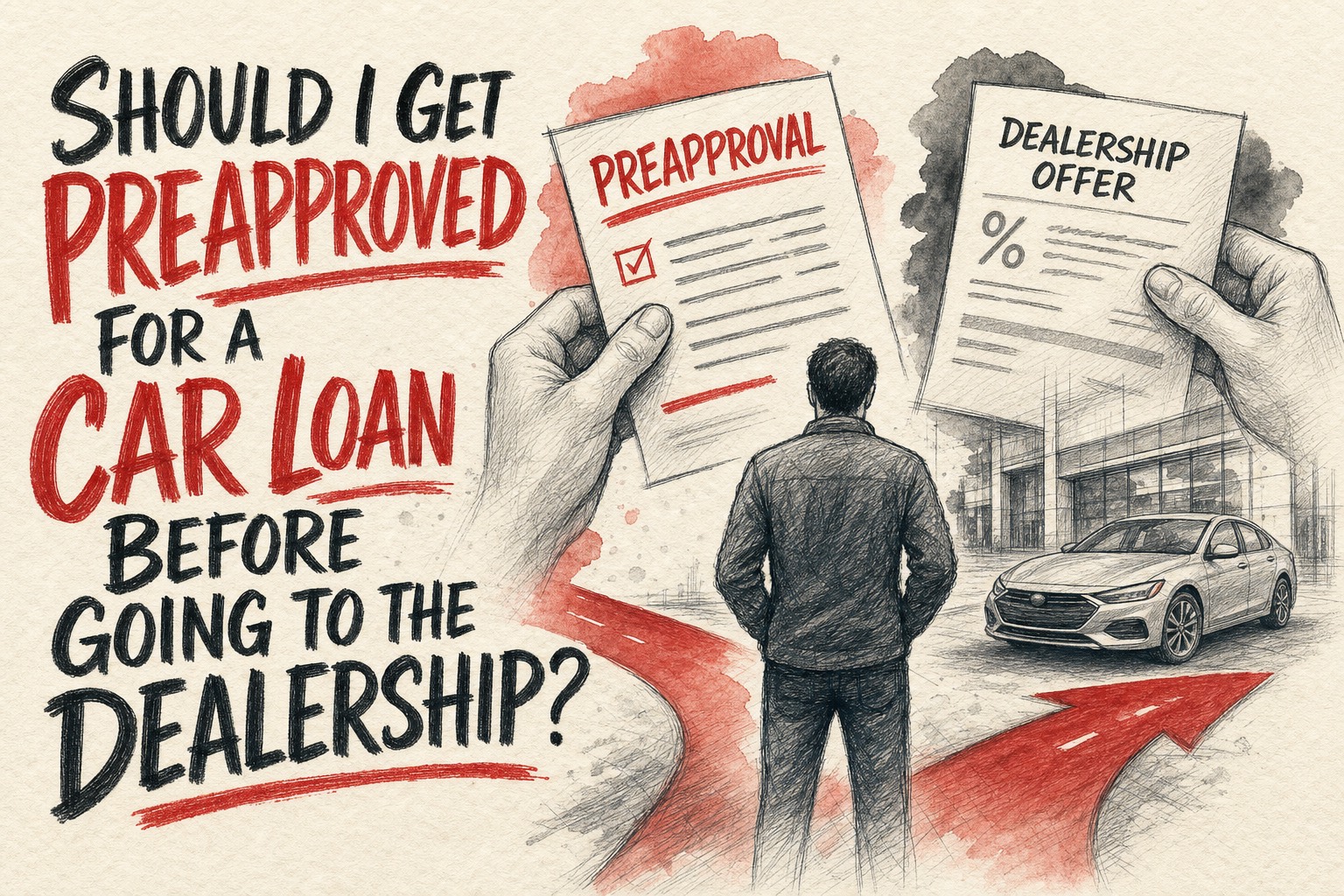
Yes. Get preapproved for a car loan before you go to the dealership, because about 78% of dealer-arranged auto loans carry a marked-up interest rate, with an average markup of 1.13 percentage points, according to a 2023 MIT analysis reported by NerdWallet. On a $40,000 loan over 60 months, a markup of that size adds roughly $21 a month and about $1,270 in interest over the life of the loan. Rolo Rides founder Andrew Eder managed a dealership finance office before he switched to the buyer's side of the desk, and the preapproval is the one piece of paper he most wants a buyer to carry into that room.
If you are the kind of buyer who has already picked the trim, the color and the option package, and you have a spreadsheet open, this question is really about certainty. You want to know that the number on the contract is the number you actually qualified for, not a number chosen for you. A preapproval gives you that reference point before anyone at the dealership has a reason to shade it.
The reality is that the dealership's finance office is not a neutral processor of your application. The Consumer Financial Protection Bureau describes dealer-arranged financing plainly: the lender gives the dealer a buy rate, and the rate you are offered is that buy rate plus additional interest that compensates the dealer for handling your financing. That extra interest is legal in most places and it is invisible on the contract. The CFPB notes you can ask whether other lenders made offers with lower rates or better terms, but the most reliable way to see the markup is to walk in already knowing what a lender will lend you on its own.
This guide covers what a preapproval is and is not, how the finance office prices a loan when you arrive without one, the arithmetic of a single point of markup on a realistic loan, and how a preapproval changes the conversation in the room. It applies anywhere in the United States: disclosure rules and markup caps vary by state and by lender, but the buy-rate mechanics of dealer-arranged financing do not change at the state line.
Key Insights
The short version for the buyer who wants the numbers: a preapproval from a bank or credit union is a real loan quote with a rate, a term and a maximum amount. The dealer's offer is the lender's buy rate plus a markup the dealer keeps, and that markup is the norm rather than the exception. On $40,000 over 60 months, one point of markup is worth about $1,120 in extra interest; the average markup is worth about $1,270. Apply for your preapprovals inside the 14 to 45 day window the CFPB describes so they count as one credit inquiry, keep the vehicle price, the trade-in and the loan as three separate negotiations, and treat the dealer's financing as one competing quote rather than the only one.
What this guide covers
- What a Car Loan Preapproval Is, and What It Is Not
- How the Finance Office Prices Your Loan When You Have No Preapproval
- The Arithmetic of One Point of Markup on a Realistic Loan
- How a Preapproval Changes the Conversation in the Room
What a Car Loan Preapproval Is, and What It Is Not
A preapproval is a lender's written answer to a specific question: based on your credit, your income and the terms you asked for, how much will we lend you, at what rate, for how long. The CFPB describes it as a loan quote that includes an interest rate, a loan length and a maximum loan amount, and notes that the quote lets you shop around and compare offers, including whatever the dealer may provide. You get it from a bank, a credit union or an online lender before you have picked a specific car, and it usually holds for a set period so you can shop with it in hand.
It is not a prequalification. A prequalification is an estimate, often from a soft credit pull, and it tells you roughly what you might qualify for. A preapproval involves a full application and a hard inquiry, and the lender is committing to terms, subject to the vehicle and the final paperwork checking out. If you want a number you can hold a dealer to, you want the preapproval, not the estimate.
It is also not a commitment to use that loan. This is the part particular buyers sometimes miss. You are under no obligation to finance with the lender who preapproved you. The preapproval exists to give you a floor. If the dealership's lender genuinely beats it on the same term, with no add-ons stuffed into the amount financed, you take the better offer and the preapproval has still done its job. If the dealer cannot beat it, you already have financing and the deal does not depend on whatever is presented in the finance office.
Three things to bring away from the application itself. First, apply for the term you actually intend to take, because a 60 month preapproval is not a fair comparison against a 72 month dealer offer, and the longer term will always show the lower payment. Second, note the maximum amount, because that is your ceiling on the out-the-door price plus anything rolled in. Third, keep the letter or the email. The dealer does not need to see it, but you need to have the rate in front of you when the finance manager slides the contract across the desk.
How the Finance Office Prices Your Loan When You Have No Preapproval
When you agree on a car and say you would like to finance it, the finance manager sends your application to lenders. The CFPB says most dealers reach out to roughly five lenders and then choose one loan to present to you. Each lender comes back with a buy rate, the minimum rate it will accept for your profile. What you are shown is not that buy rate. It is the buy rate plus additional interest that, in the CFPB's words, compensates the dealer for handling your financing. NerdWallet reports that the markup is usually capped by lender policy and state law at about 2 to 3 percentage points.
The scale of it is not a guess. According to a 2023 analysis by the Massachusetts Institute of Technology, as reported by NerdWallet, about 78% of dealer-arranged loans carry marked-up interest rates, and the average markup is 1.13 percentage points. That is an industry average across every credit tier, not a claim about any one store, and it is not Rolo Rides data. Andrew ran a finance office and his own published description of that room matches the study: it is where the interest rate gets marked up, where warranty products and add-ons are sold, and where last-minute fees appear.
None of this makes the finance manager a villain. The markup is a compensation structure, and the person across the desk is doing the job the dealership hired them to do. The problem is purely informational. You cannot see the buy rate, you cannot see which of the five lenders offered what, and the contract shows only the final rate. A buyer with no reference point has nothing to measure the number against, so the number tends to stand. If you want the full anatomy of that room, from the sequencing of the product menu to how the profit is tracked, read what actually happens in the dealership finance office. This article stays on the one decision that changes the arithmetic before you get there.
There is one more mechanism worth naming, because it is the reason the markup survives even when buyers are careful. The conversation in the finance office is built around the monthly payment. A 1.13 point markup on $40,000 shows up as about $21 a month, which is small enough to disappear inside a payment that was already going to be several hundred dollars. Framed as a payment, it looks like nothing. Framed as total interest over the term, it is well over a thousand dollars. The next section does that math so you can check it.
- The lender's buy rate is the real rate. The contract rate is the buy rate plus the dealer's markup.
- Dealers typically submit to roughly five lenders and present one offer (CFPB).
- The markup hides inside the monthly payment, which is why the conversation is steered there.
The Arithmetic of One Point of Markup on a Realistic Loan
Here are the assumptions, stated so you can change them. Amount financed: $40,000. Term: 60 months. Your preapproved rate from a credit union: 6.00%. The dealer's presented rate with the study's average markup applied: 7.13%. The payment formula is the standard amortization formula, payment = P x i / (1 - (1 + i)^-n), where P is the amount financed, i is the monthly rate (annual rate divided by 12) and n is the number of payments. Any loan calculator will reproduce these figures.
At 6.00% over 60 months, the payment is $773.31 and the total interest paid over the life of the loan is $6,398.72. At 7.13% over the same 60 months, the payment is $794.50 and the total interest is $7,670.22. The difference is $21.19 a month and $1,271.50 in total interest. That is what the average markup in the MIT analysis costs on a $40,000 loan, if your buy rate would otherwise have been 6.00%. Round it to $1,270 and you have the number to carry in your head.
Change the term and the number grows, which is the second reason the finance office prefers longer loans. On the same $40,000 at 72 months, 6.00% produces a $662.92 payment and $7,729.92 in interest; 7.13% produces $684.46 and $9,281.12. The monthly difference is still about $21, but the total interest difference is $1,551.20. The payment gap barely moves. The cost gap grows by almost $280. Whenever a longer term is offered as the way to get your payment down, that is the trade being made.
Now scale it. On $30,000 over 60 months the same markup costs $953.62 in extra interest. Every additional $10,000 financed adds roughly $320 to the cost of a 1.13 point markup at 60 months. And remember that the study's 1.13 points is an average; NerdWallet reports that lender policy and state law usually cap the markup at about 2 to 3 points, so a buyer with strong credit and no preapproval can pay more than the average. The published Rolo Rides worked example uses the same logic in the other direction, putting 1 to 2 percentage points of financing rate protection on a $50,000 new vehicle at roughly $1,400. That figure is a typical historical outcome from past clients, not a promise, and every deal is different. What matters here is that you can run the same formula on your own numbers before you leave the house.
- $40,000 over 60 months: 6.00% costs $6,398.72 in interest; 7.13% costs $7,670.22. Difference: $1,271.50.
- Same loan over 72 months: the payment gap stays near $21, the interest gap grows to $1,551.20.
- Rule of thumb from these figures: about $320 of extra interest per $10,000 financed for a 1.13 point markup at 60 months.
- Assumptions are yours to change. The formula, not the example, is the point.
How a Preapproval Changes the Conversation in the Room
The first change is structural. Without a preapproval, the dealer's financing is the only offer on the table and the finance office is the place where the terms get set. With one, the dealer's financing becomes one competing quote. The CFPB frames the strategy exactly this way: getting preapproved by a bank or credit union lets you show a dealership the rates you have been offered, with the goal of getting competitive offers. NerdWallet's advice is the same, and it adds the useful detail that a dealer trying to meet or beat your preapproved rate has less room to mark up the buy rate. The dealer can still win your loan. They just have to earn it against a number you brought.
The second change is that you can keep the three negotiations separate. The vehicle price, the trade-in and the loan are three different transactions that the dealership prefers to blend into one monthly payment, because a blended number hides which part moved. Settle the out-the-door price of the car first, in writing. Settle the trade-in as its own number. Then, and only then, compare financing on the same term and the same amount financed. The Rolo Rides how-it-works page describes the Buying Phase as exactly this: price and fees, finance structure and trade-in value, evaluated separately and then brought together as one coordinated transaction.
The third change is timing, and it matters for your credit score. Multiple hard inquiries in a short window are treated as one for scoring purposes. The CFPB advises keeping auto loan credit inquiries within 14 to 45 days of each other so they are counted as only one inquiry, and it notes that a dealer may send your application to roughly five lenders, so the whole car-buying process is best kept to a few weeks. In practice, get two or three preapprovals in the same week or two, then shop. Do not get preapproved in March and buy in June.
A few practical rules for the room itself. If the dealer says they can beat your rate, ask for the new rate on the same term, and ask for the total amount financed to be identical to the price you agreed plus taxes and government fees. A lower rate on a longer term, or a lower rate with a protection package quietly added to the balance, is not a better loan. Ask whether there is a prepayment penalty; the CFPB lists it among the terms you can negotiate away. And if the loan is not finalized in writing, do not drive the car home. If your credit is thin or damaged, the same principles apply with more force, and how to buy a car with bad credit covers the specific traps that stack on top of a higher base rate. If you want to know what rate to expect before you apply, what a good interest rate on a car loan looks like in 2026 gives ranges by credit tier.
Want the Financing Checked Before You Sign?
Rolo Rides is a flat $999 car buying advocacy service that works by phone anywhere in the United States. Andrew Eder managed a dealership finance office and now reviews the rate, the fees and the add-ons on every deal for the buyer, coordinating with your own bank or credit union and accepting no compensation from any dealership. If you would rather have the arithmetic checked by someone who has sat on the other side of that desk, see how the process works or book a free discovery call.
Frequently asked questions
Q: Should I get preapproved for a car loan before going to the dealership?
A: Yes. A car loan preapproval before the dealership gives you a real rate, term and maximum amount from a bank or credit union, which is the only reference point you will have when the finance office presents its offer. About 78% of dealer-arranged loans carry a marked-up rate, averaging 1.13 percentage points, according to a 2023 MIT analysis reported by NerdWallet. With a preapproval in hand, the dealer's financing becomes one competing quote, and if the dealer beats it on the same term you simply take the better loan.
Q: Will getting several preapprovals hurt my credit score?
A: Not if you keep them close together. The Consumer Financial Protection Bureau advises keeping auto loan credit inquiries within 14 to 45 days of each other so they are counted as a single inquiry for scoring purposes. A dealer may submit your application to roughly five lenders as well, so the practical approach is to apply to two or three lenders in the same week or two and then buy within a few weeks, rather than spreading applications across months.
Q: Does a preapproval mean I have to use that lender?
A: No. A preapproval is a floor, not a commitment. If the dealership's lender beats your preapproved rate on the same term and the same amount financed, with no add-ons rolled into the balance, take the better offer. If the dealer cannot beat it, you already have financing and the purchase does not depend on anything presented in the finance office. Either way, the preapproval has done its job by making the dealer's offer compete.
Q: How does a car buying advocate handle the financing on a purchase?
A: Rolo Rides handles the financing evaluation as part of its flat $999 service, which works by phone across the United States. Andrew Eder, who managed a dealership finance office, coordinates with the buyer's own bank or credit union, checks the presented rate against the buyer's own preapproval, on the same term and amount financed, audits dealer fees and add-ons, and keeps the vehicle price, trade-in and loan as separate negotiations. He accepts no compensation from any dealership. A free discovery call is the first step, and he will say plainly whether he can add enough value to justify the fee.
Citations
- Do Car Dealers Make Money on Financing? (NerdWallet). Explains dealer reserve and the buy rate, reports the 2023 MIT analysis finding that about 78% of dealer-arranged loans carry marked-up rates with an average markup of 1.13 percentage points, and recommends bringing a preapproved loan to the dealership. Updated September 15, 2026. https://www.nerdwallet.com/auto-loans/learn/dealers-profit-off-financing
- What are the different ways to buy or finance a car or vehicle? (Consumer Financial Protection Bureau). The CFPB's description of dealer-arranged financing: the lender's buy rate plus additional interest that compensates the dealer, dealers contacting roughly five lenders and presenting one offer, and preapproval from a bank or credit union as the cheaper route and the basis for comparison. Also states that credit inquiries within 14 to 45 days are treated as one. https://www.consumerfinance.gov/ask-cfpb/what-is-the-difference-between-dealer-arranged-and-bank-financing-en-759/
- What things can I negotiate when shopping for a car or auto loan? (Consumer Financial Protection Bureau). Lists the negotiable elements of an auto loan, including the interest rate and APR, loan length, prepayment penalties, optional add-on products, trade-in value and dealer fees, and recommends getting preapproved by a bank or credit union to show the dealership competing rates. https://www.consumerfinance.gov/ask-cfpb/what-things-can-i-negotiate-when-shopping-for-a-car-or-auto-loan-en-2132/
- What should I know before I shop for a car or auto loan? (Consumer Financial Protection Bureau). Source for the credit inquiry window: keep auto loan credit inquiries within 14 to 45 days of each other so they count as one inquiry, and keep the car-buying process to a few weeks because a dealer may contact roughly five lenders. https://www.consumerfinance.gov/ask-cfpb/what-should-i-know-before-i-shop-for-auto-loan-at-a-bank-credit-union-dealership-or-other-lender-en-755/
Related reading
- What Is a Good Interest Rate on a Car Loan in 2026?
- How to Buy a Car with Bad Credit Without Getting Taken Advantage Of
- How Much Should I Put Down on a Car?
- The Complete Car Buying Checklist: Every Step From Research to Keys in Hand
- What Actually Happens in the Dealership Finance Office
- How It Works: the Shopping Phase and Buying Phase System

About the Author
Andrew Eder is the founder of Rolo Rides, a flat-fee car buying advocacy service based in Austin, Texas. Before switching sides to represent buyers, Andrew spent five years inside four dealerships, including Honda, Mazda, and Lexus, where he worked in sales and managed the finance office. That experience gave him direct insight into how vehicles are priced, how interest rates are marked up, and how the finance office generates profit most buyers never see. Andrew holds a degree in Electrical Engineering from Milwaukee School of Engineering. He has facilitated over 1,000 vehicle transactions across 9 states and built Rolo Rides on a simple principle: charge the buyer a flat fee, accept zero compensation from the dealership, and protect every part of the deal.